

The markets, much like a poker game, give us a new set of cards each week. While we can't change the cards themselves, how we analyze, interpret, and act on them is entirely within our control. This post is part of my ongoing process to review the landscape and, with the help of technology, share insights for others who might find it valuable. As always, I welcome any feedback on how we can continue to improve and refine this experiment.
Now, onto this week’s cards…
Market Overview
This week, the markets navigate a complex mix of strong U.S. economic data, escalating geopolitical tensions in the Middle East, and divergent central bank policies across major economies. Despite these challenges, the S&P 500 continues its upward trajectory, closing last week at 5,751.07, just shy of its all-time high.
Transition from Last Week
Economic Data: The U.S. labor market showcased its resilience with a robust Nonfarm Payrolls report of 254,000, significantly surpassing the expected 150,000. Unemployment has declined to 4.1%, and wage growth increased by +0.4%, underscoring the strength of the U.S. economy, which accounts for 27% of global GDP.
Geopolitical Risks: Rising tensions between Israel and Iran have heightened geopolitical risks, particularly affecting energy markets. West Texas Intermediate (WTI) crude oil prices have surged to $75 per barrel due to fears of potential supply disruptions.
Central Bank Policies:
China (17% of Global GDP): Optimism is growing as China signals further efforts to stimulate domestic consumption through fiscal measures like tax cuts and increased infrastructure spending. These initiatives could boost global commodity demand and supply chains.
Japan (4% of Global GDP): The new premier of Japan surprised markets by stating that the Japanese economy is not ready for further interest rate hikes, indicating a continuation of the current ultra-loose monetary policy.
Global Macro View: What's Driving the Market
1. Geopolitical Tensions in the Middle East
Insight: The escalating conflict between Israel and Iran raises concerns about significant disruptions to global oil supplies. Any military action could lead to a substantial spike in oil prices.
Impact:
Energy Sector: Potential for outperformance due to rising oil prices.
Defense Sector: Increased demand as geopolitical tensions heighten.
Inflationary Pressures: Higher oil prices could contribute to inflation, impacting consumer spending and corporate profit margins.
Takeaway: Consider increasing exposure to energy and defense sectors. Monitor industries vulnerable to higher oil prices, such as transportation and logistics, which may face headwinds.
2. Strong U.S. Economic Data
Insight: Robust labor market data highlights the underlying strength of the U.S. economy, reducing the likelihood of aggressive rate cuts by the Federal Reserve.
Impact:
Interest Rates: Expectations for further Fed rate cuts have diminished, with markets now pricing in only a potential 25 basis point cut in November.
Sectors to Watch: Companies benefiting from strong domestic consumption, like technology and industrials, may perform well.
Risks: Rising interest rates could pressure high-debt companies and interest-rate-sensitive sectors such as real estate and utilities.
Takeaway: Focus on companies with solid balance sheets and strong domestic revenue streams. Exercise caution with high-debt companies due to potential increases in borrowing costs.
3. Global Central Bank Easing
Insight: Central banks outside the U.S. are leaning towards monetary easing, leading to a divergence in global monetary policies.
China: The government's push to stimulate domestic consumption could boost economic growth, affecting global markets.
Japan: The premier's stance on maintaining low interest rates suggests continued support for economic growth, potentially impacting currency exchange rates.
Impact:
Currency Markets: The U.S. dollar may strengthen against weaker foreign currencies like the yen and yuan, potentially affecting multinational companies' earnings.
Investment Opportunities: A stimulative global environment could support international equities, particularly in emerging markets benefiting from local stimulus measures.
Takeaway: Be mindful of currency risks when investing abroad. Opportunities may exist in emerging markets and international equities poised to benefit from regional economic stimulus.
4. Energy Market Dynamics
Insight: Rising oil prices due to geopolitical fears and potential supply disruptions present both opportunities and risks.
Impact:
Energy Sector: Likely to outperform amid higher oil prices.
Affected Industries: Sectors like airlines and logistics could face margin pressures due to increased fuel costs.
Takeaway: Consider allocating exposure to energy stocks or ETFs to capitalize on rising oil prices. Monitor industries adversely affected by higher energy costs and adjust positions accordingly.
Market Indicators & Trends
Sentiment and Volatility Analysis
1. SPX E-mini Futures (ES) Price Action
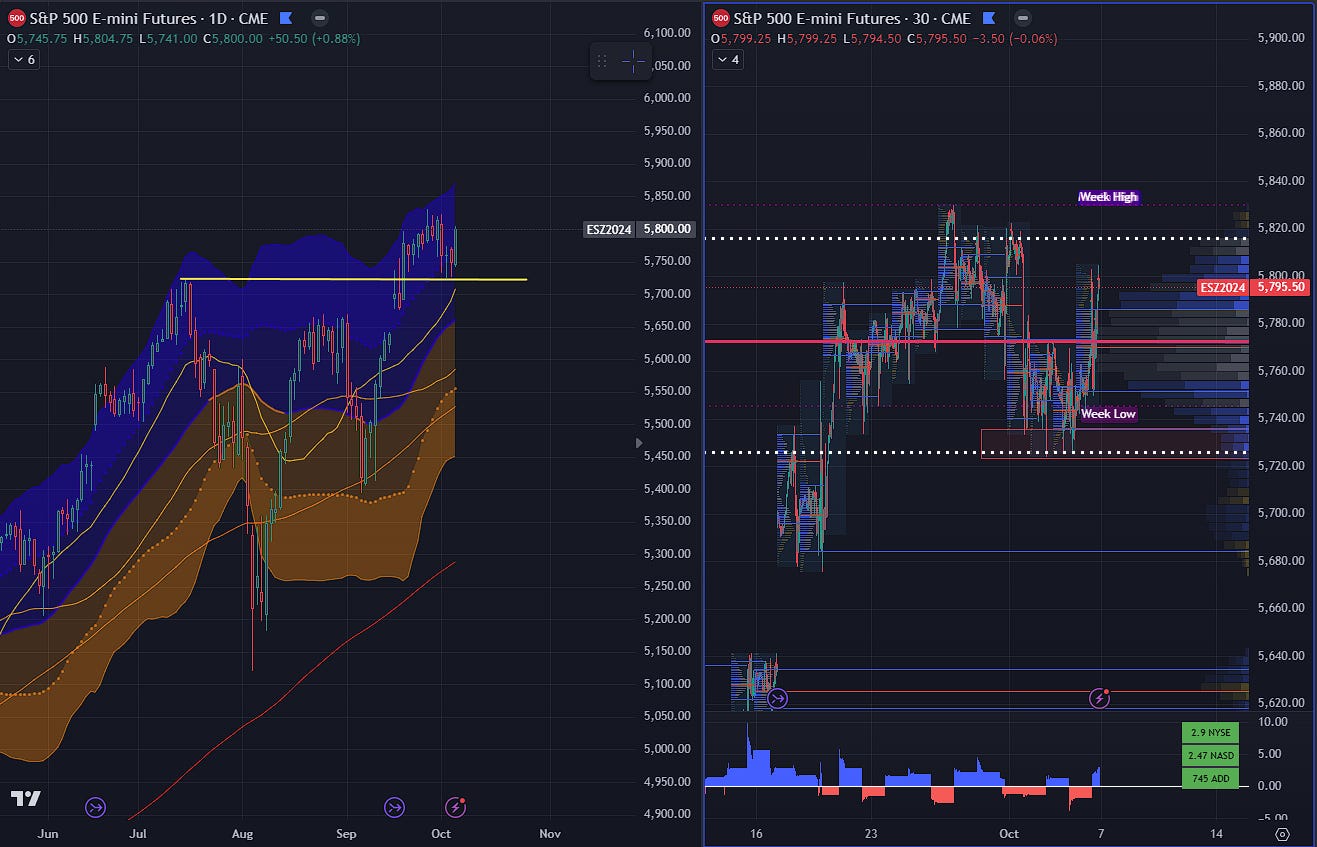
2. AAII Bearish Sentiment
Current Reading: The AAII Bears sentiment is at 27.30%, relatively low.
Interpretation: Indicates moderate bearish sentiment, implying a bullish or neutral outlook.
3. Volatility Index (VIX)
Current Level: The VIX is at 19.21, suggesting calm market conditions with potential for volatility to rise.
Potential for Change: A breakout above the 20-25 range could signal increased volatility and potential downside risks.
4. Put/Call Ratio
Current Reading: The Put/Call ratio is at 1.02, indicating a neutral market stance with slight protective positioning.
Key Takeaways:
Bullish Continuation: Low VIX and balanced sentiment indicate continued market strength.
Risk Management: Monitor for volatility spikes or a sharp rise in the Put/Call ratio.
Market Breadth Indicators
Breadth Analysis: Percentage Above 20-Day EMA
S&P 500
62.60% of stocks are above their 20-day EMA.
Interpretation: Positive sign of market breadth; the majority of stocks are participating in the rally.
Midcap Index
63.75% of stocks are above their 20-day EMA.
Interpretation: Healthy breadth in midcaps confirms broader market participation.
Smallcap Index
53.17% of stocks are above their 20-day EMA.
Interpretation: Slightly lower participation; small-caps are strong but lagging behind larger stocks.
Nasdaq
55.00% of stocks are above their 20-day EMA.
Interpretation: Reflects strong performance from the tech sector; not yet overheated.
Key Takeaways:
Market Breadth: A majority of stocks across indices are in bullish trends.
Strong Participation: Both blue chips and growth stocks are driving the market higher.
Monitoring Required: Watch for overextension; if these percentages rise significantly above 80%, it could signal overbought conditions and a potential market pullback.
S&P 500 Insights: Trading Patterns and Volume Analysis
Recent Trading Patterns
Opening Gap
Last 7 Days: Strong opening gap performance (+0.80% on 4-Oct, +1.72% on 19-Sep).
Last 30 Days: Positive average return (+0.18%), consistent gains.
Takeaway: High probability of gains; consider trading the opening gap.
3-4 PM (End-of-Day)
Last 7 Days: Consistent positive returns (+0.27% on 4-Oct), end-of-day strength.
Last 30 Days: Positive average return (+0.08%), 68% positive days.
Takeaway: End-of-day momentum is reliable; consider entering positions in the final hour.
Volume (3-4 PM)
Last 7 Days: Lower volume (7.55M on 4-Oct) but still positive returns.
Last 30 Days: Higher average volume (9.60M), end-of-day momentum.
Takeaway: Lower volume but strong performance suggests strategic positioning towards the close.
Opening Hour (9:30-10 AM)
Last 7 Days: Increased selling pressure, greater negative returns (-0.34% on 4-Oct).
Last 30 Days: Mild negative average return (-0.07%), consistent weakness.
Takeaway: Avoid trading during the opening hour due to high selling pressure.
1-2 PM Hour
Last 7 Days: Mixed results, weaker momentum (-0.12% on 4-Oct, +0.18% on 3-Oct).
Last 30 Days: Positive average return (+0.04%), 61% positive days.
Takeaway: Weaker momentum recently; exercise caution or reduce exposure during this time frame.
Volume (9:30-10 AM)
Last 7 Days: Higher volume (5.38M on 4-Oct), indicating increased activity.
Last 30 Days: Lower average volume (4.13M), moderate selling pressure.
Takeaway: High volume does not correlate with positive returns; avoid aggressive trading during this period.
Volatility
Last 7 Days: Increased volatility during the open; larger negative deviations.
Last 30 Days: Lower average volatility, more stable patterns.
Takeaway: Increased volatility suggests higher risk during the opening hour; adjust position sizing accordingly.
Overall Takeaways:
Opening Gap Strategy: Despite strong opening gap performances, increased selling pressure and higher volatility during the opening hour suggest caution. High volume does not necessarily translate into positive returns. Consider avoiding aggressive trades during the first hour.
End-of-Day Strength: Consistent positive returns and reliable end-of-day momentum indicate potential opportunities. Lower volume but strong performance in the 3-4 PM time frame suggests strategic positioning towards the close could be beneficial.
Midday Trading: Mixed results and weaker momentum during the 1-2 PM hour advise caution. It's prudent to reduce exposure or closely monitor positions during this period.
Volatility Consideration: Increased volatility during market open implies higher risk. Traders should adjust position sizing and employ risk management strategies accordingly.
Last 7 Days:
Most Common Low Times:
11-12 PM and 9:30-10 AM both occurred 2 times.
12-1 PM, 10-11 AM, and 1-2 PM each occurred 1 time.
Most Common High Times:
2-3 PM occurred 4 times.
3-4 PM, 10-11 AM, and 1-2 PM each occurred 1 time.
Last 30 Days:
Most Common Low Times:
9:30-10 AM: Occurred 12 times.
2-3 PM: Occurred 6 times.
Most Common High Times:
3-4 PM: Occurred 9 times.
11-12 PM: Occurred 6 times.
Insights:
In the last 7 days, the 2-3 PM window dominated the highs, while the lows were more dispersed between 11-12 PM and 9:30-10 AM.
In the last 30 days, lows were more concentrated in the early morning (9:30-10 AM), and highs often occurred during the 3-4 PM period.
This suggests a general tendency for lows to happen earlier in the day and highs later, though in the past 7 days, the highs clustered around 2-3 PM
Key Events and Strategies
Economic Reports
Monday, October 7
Consumer Credit: Offers insights into consumer spending and debt levels.
Tuesday, October 8
Trade Balance: May impact currency markets and multinational companies.
Earnings: PepsiCo (PEP) - Focus on consumer spending trends amid rising inflation.
Wednesday, October 9
EIA Crude Oil Inventories: Significant for energy markets given rising oil prices.
Earnings: AZZ Inc. (AZZ) - Provides industrial manufacturing insights.
Event: NVIDIA (NVDA) AI Summit continues in Washington, D.C.
Focus: Discussions on AI developments in cybersecurity, healthcare, telecommunications, and more.
Impact: Potential catalysts for NVDA stock and the broader AI and semiconductor sectors.
Thursday, October 10
CPI Report & Core CPI: Key inflation data that could influence Fed policy expectations.
Earnings: Delta Air Lines (DAL) - Impact of fuel costs on profitability.
Event: Tesla (TSLA) Robotaxi Event
Potential Catalyst: Could influence Tesla and the autonomous vehicle market.
Event: Advanced Micro Devices (AMD) "Advancing AI" Event
Focus: AMD to unveil new AI solutions and processors.
Impact: Could influence AMD stock and the semiconductor industry.
Friday, October 11
PPI Report: Additional inflation insights.
Earnings: Major banks reporting, including JPMorgan Chase (JPM), Wells Fargo (WFC), and BlackRock (BLK), setting the tone for financials.
Strategies
Inflation Data: Volatility may increase around CPI and PPI releases. Prepare for potential market reactions.
Earnings Season Kickoff: Monitor financial sector earnings for insights into overall market health.
Tech Events: Stay informed on announcements from NVIDIA's AI Summit and AMD's event, which could impact the tech and semiconductor sectors.
Investment Themes & Opportunities
1. Energy Sector Revival
Focus Stocks/ETFs: ExxonMobil (XOM), Chevron (CVX), Energy Select Sector SPDR Fund (XLE)
Insights: Rising oil prices due to geopolitical tensions could benefit energy stocks, especially with historically low hedge fund positioning in the sector.
Strategy:
Opportunities: Increase exposure to energy stocks or ETFs.
Considerations: Stay informed about geopolitical developments.
Takeaway: The energy sector presents opportunities amid rising oil prices but requires careful risk management.
2. Technology Sector Dynamics
Focus Stocks: NVIDIA (NVDA), Advanced Micro Devices (AMD), Meta Platforms (META)
Insights:
NVIDIA (NVDA): Hosting an AI Summit with potential announcements that could be catalysts for the stock.
AMD: Showing technical strength with a MACD bull cross and a breakout from a bull flag pattern.
Tech Sector Rotation: Despite selling in mega-cap tech stocks, renewed interest is seen in other tech areas like semiconductors and software.
Strategy:
Opportunities: Invest in high-quality tech companies with growth prospects.
Considerations: Monitor interest rate movements and event outcomes.
Takeaway: The tech sector offers growth opportunities, particularly in AI and semiconductors.
3. Healthcare Sector Strength
Focus ETFs/Stocks: Health Care Select Sector SPDR Fund (XLV), UnitedHealth Group (UNH)
Insights: Hedge funds have bought the dip in global healthcare stocks.
Strategy:
Opportunities: Add exposure to healthcare stocks or ETFs.
Considerations: Healthcare provides stability amid volatility.
Takeaway: Healthcare may balance growth and defense in portfolios.
4. Emerging Markets Growth
Focus ETFs: KraneShares CSI China Internet ETF (KWEB), iShares MSCI China ETF (MCHI)
Insights: Optimism on China's economic stimulus is boosting Chinese equities.
Strategy:
Opportunities: Allocate to China-focused ETFs.
Considerations: Be prepared for higher volatility.
Takeaway: Emerging markets may offer growth opportunities with additional risks.
5. High Volatility Trades
Focus Stocks: Tesla (TSLA), Alibaba (BABA), MicroStrategy (MSTR)
Insights: Elevated implied volatility presents options strategies opportunities.
Strategy:
Opportunities: Implement premium-selling strategies like iron condors.
Considerations: Ensure proper risk management.
Takeaway: Options strategies can be effective but require careful planning.
6. Defensive Sector Weakness
Focus ETFs: Utilities Select Sector SPDR Fund (XLU), Real Estate Select Sector SPDR Fund (XLRE)
Insights: Defensive sectors are underperforming amid rising interest rates.
Strategy:
Opportunities: Hedge against declines in these sectors.
Considerations: Maintain flexibility in your approach.
Takeaway: Caution is advised with defensive sectors.
Risk Management
Primary Risks
Inflation Surprises
Impact: Higher-than-expected CPI or PPI readings could lead to market volatility.
Strategy: Diversify investments and monitor economic indicators closely.
Geopolitical Escalations
Impact: Further tensions could disrupt markets, especially energy prices.
Strategy: Stay informed and adjust portfolio allocations accordingly.
Secondary Risks
Earnings Season Volatility
Impact: Disappointing earnings could lead to market corrections.
Strategy: Keep a balanced portfolio and stay updated on earnings announcements.
Central Bank Policies
Impact: Diverging policies might affect currency markets.
Strategy: Consider currency exposure and focus on companies with strong domestic revenues.
Conclusion
The upcoming week presents a combination of opportunities and challenges. Strong U.S. economic data offers support for equities, but geopolitical tensions and potential inflationary pressures add layers of uncertainty.
Key Points to Consider
Energy Sector Opportunities: Rising oil prices make the energy sector attractive.
Technology Sector Events: NVIDIA's AI Summit and AMD's event could be catalysts.
Stay Informed on Economic Data: Inflation reports could impact market sentiment.
Risk Management: Use protective strategies to hedge against volatility.
Stock Picking Importance: Selective investment decisions are crucial.
Action Items for the Week
Monitor Key Economic Releases: CPI and PPI reports on Thursday and Friday.
Attend Tech Events: Follow NVIDIA's AI Summit and AMD's event for potential market-moving news.
Review Portfolio Allocations: Adjust exposure based on the current market outlook.
Stay Updated on Geopolitical Developments: Monitor Middle East tensions.
Prepare for Earnings Season: Analyze companies reporting earnings this week.
Staying informed and proactive in your investment approach will be key to navigating the markets in the week ahead.
Disclaimer: This report is for informational purposes only and does not constitute investment advice. Please conduct your own research or consult a financial advisor before making any investment decisions.
Appreciate the insights LW. This section is particularly helpful for my approach: "S&P 500 Insights: Trading Patterns and Volume Analysis"