

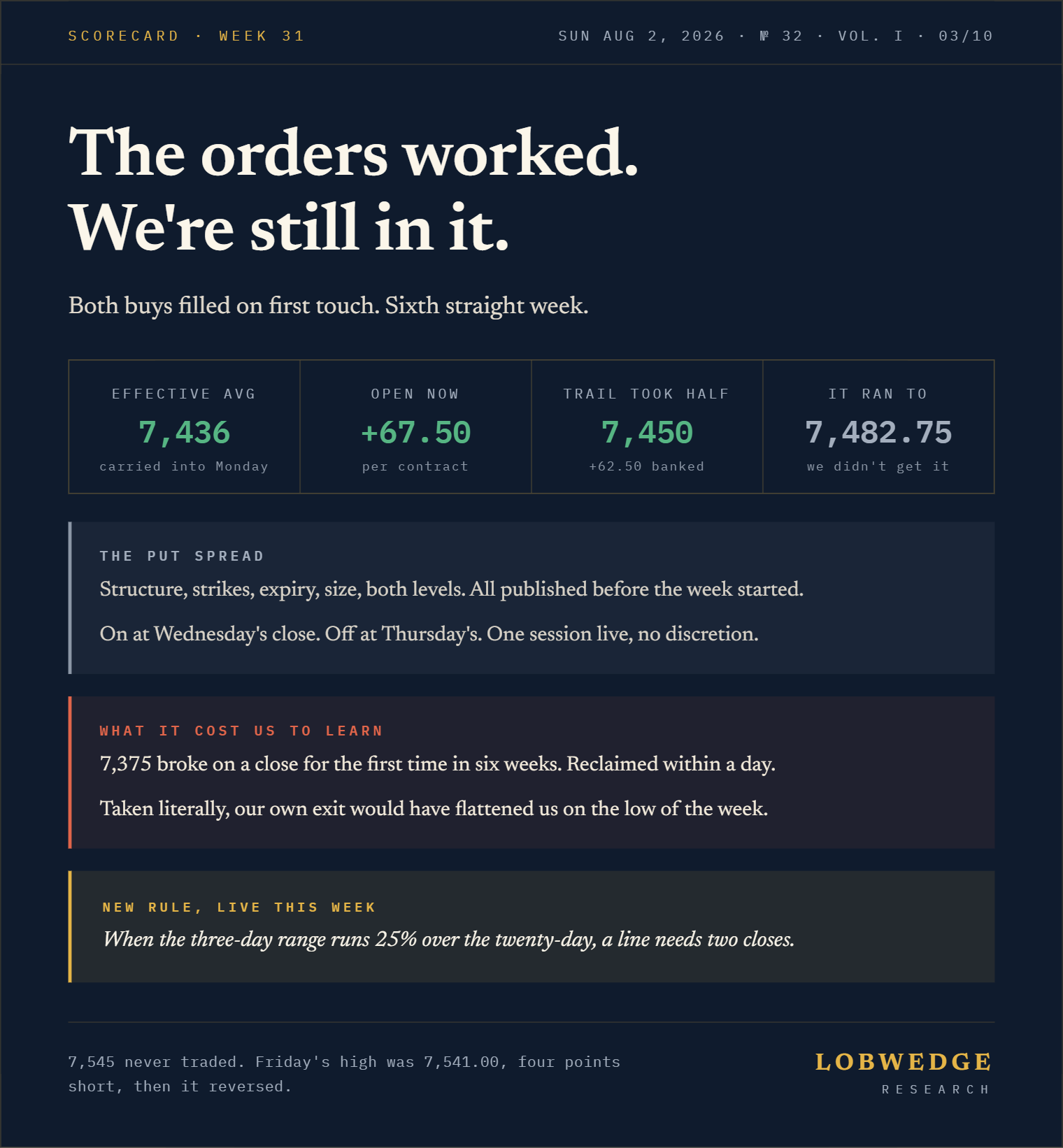
Last Sunday we put two buy orders below the market at 7,400 and 7,375, an average of 7,387.50, and said we’d get out on a daily close below 7,375.
Wednesday, on Fed day, price fell to 7,324 and filled both on the first touch. That’s the sixth straight week the first test of a published line has been the entry.
It ran to 7,482.75, ninety-five points above the average. We didn’t get that. The trail took half off at 7,450, banking 62.50 points. We kept the rest and added back at the pivot after Wednesday.
So we’re still long, at an effective 7,436, about 67 points green at Friday’s settlement. The table below is how that average got there. It’s the actual position. Not an illustration.
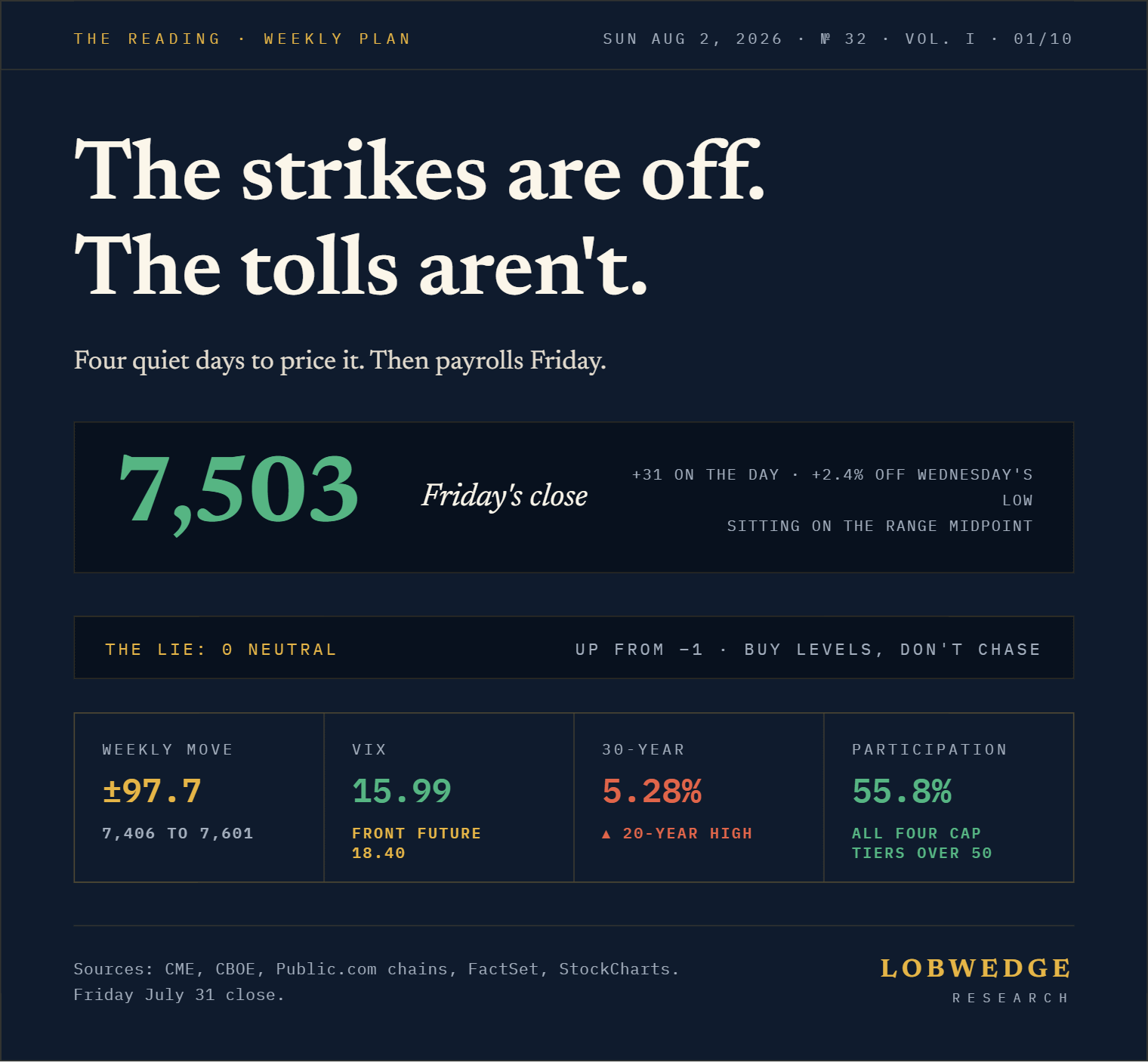
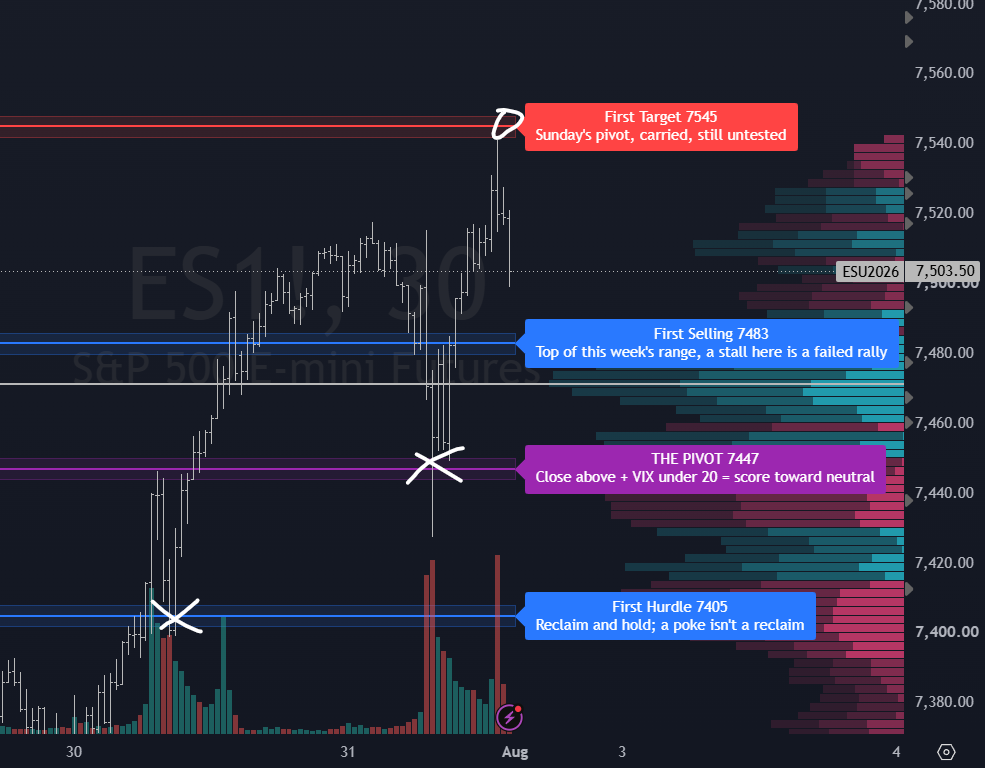
Then Thursday and Friday erased the whole decline. Price closed the week at 7,503.50, up 2.4% from Wednesday’s low, and the condition we published mid-week completed inside a single session.
How that average got to 7,436
If you trade ES actively, this is worth five minutes. It’s a way of lowering what a position costs you while the market goes nowhere.
Thursday’s range was 167 points. The twenty-day average is 80. In a market that wide the same sixty-point swing gets handed to you two or three times a week. Flipping long to short pays the spread on both sides and gets whipsawed by moves inside a single day’s noise. Working one direction and scaling around it turns that swing into a better basis.
The key idea is that your book average and what the position actually costs you are two different numbers. Once you bank a scale, the profit is real. It belongs to the contracts you still hold.
Effective average = book average, minus banked points divided by contracts you still hold.
Here it is on a normal size of ten, using last week’s prices.
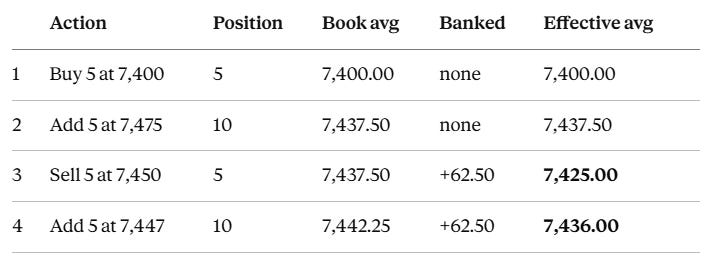
Step 3 is the one people skip. You sold into strength at a level, banked 62.50 points, and the five you kept now cost an effective 7,425 instead of 7,437.50. Your broker still shows 7,437.50. Your broker isn’t tracking your P&L.
Step 4 puts you back to full size at an effective 7,436, eleven points better than the price you just paid.
At Friday’s 7,503.50 that’s 675 points open on ten contracts. Buying all ten at 7,437.50 and sitting still gets you 660. The dollars barely differ. What differs is that you spent Fed day at half size and still finished fully positioned at a better basis.
Three things that matter more than the arithmetic.
You never have to add back. Holding five at an effective 7,425 all week is a perfectly good outcome. Smaller at a better basis beats full size at a worse one.
The level does the work, not the view. Every action above happens at a price that was on the map before the week started. Nothing here requires being right about direction.
Everything below is for paying subscribers: the score, the map, the trade, and the names we’re buying at their own levels.
