

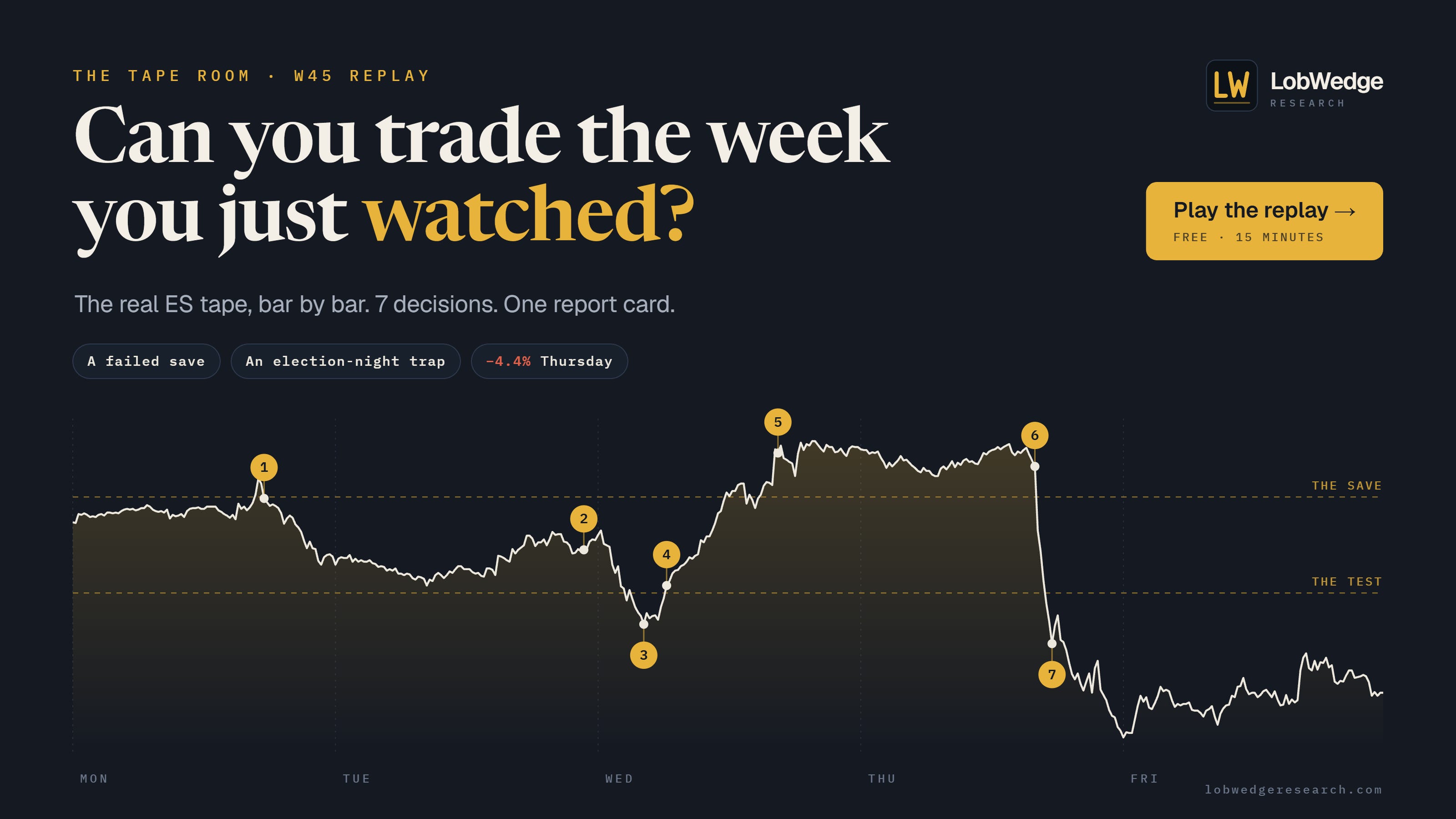
The map did its job this week. The save (7,667) failed exactly the way the Sunday note said to fade it. The test (7,538) broke on election night and turned into the trap we wrote about. Wednesday’s rally stopped less than a point under the first target. And on Thursday, the rules pulled the first buy before the S&P 500 had its worst day since April 2025.
So this one isn’t about the levels. It’s about you.
Close the platform. Pour something. Let’s do the session.
“Walk me through Monday at 10:15.”
ES ran 27 pts through the save in the first hour. It looked like a breakout. What did you feel?
If the answer is “I had to be in it,” that’s FOMO, and it’s the most expensive feeling in this business. Here’s what the tape was actually saying while your chest got tight:
NYSE TICK peaked at +1,206 at the open and made lower highs (+563) as price pushed higher. Price went up, buy programs didn’t.
The next 2 bars both had net selling, and the second one closed back under 7,667.
Breadth was fine. Money was rotating out of tech, not out of stocks.
ES closed the day 91 pts under the save. The trade was there. It just showed up 30 minutes after the moment that felt urgent.
The question to sit with: when price pokes through a level, do you wait for the close, or do you chase the poke?
“Why did you still have it on Tuesday night?”
Say you took the put spread. By Tuesday’s close it had done almost all of its work. SPX settled under the short strike. Then the polls closed.
By Wednesday’s expiry SPX settled at 7,689 and the spread was worthless.
Nobody holds a nearly-full spread into a coin flip because the math says so. They hold it because closing it feels like admitting the trade is over. That’s attachment, and it feels like conviction.
Our options ideas are 0 to 5 day trades. We grade them on the best managed exit inside that window, never on what they’re worth at expiration.
The question to sit with: when a trade has done its job, can you let it go?
“What did you do when the test broke?”
Election night. ES lost 7,538 after 8 PM and printed 7,490. Every screen said the floor was gone.
Fear says get short or get out. But look at what the break was made of:
Overnight bars trading about 1/15 of a normal cash-session bar
Net selling of a few hundred to 1,500 contracts per bar. Nobody big was pressing it.
Then buyers won 2 bars in a row, and ES closed back above 7,538 at midnight.
That reclaim was the entry, with the stop under the flush low. It ran to 7,687 by 7 AM.
A thin break is a question. The reclaim is the answer.
The question to sit with: do you act on the drop, or on the confirmation?
“You were up 190 points. Where did it go?”
Wednesday’s rally stalled at 7,746.25. A sell order parked exactly on the 7,747 first target never filled.
Traders who scaled into the zone and trailed the rest under the save kept most of the move. Traders who held full size with no plan watched it go underwater on Thursday.
Targets are zones, not prints. Wanting the last point is how you lose the first hundred.
The question to sit with: do you have an exit plan before you’re in profit, or do you make it up once you’re in profit?
“Thursday morning. Your buy is resting at 7,714. Talk to me.”
This is the one that matters.
Overnight, Qualcomm (QCOM) guided weak. Chips were red before the bell. ES slipped under the first buy with sellers in control. Wednesday had been a relief rally.
The setup checklist said 0 of 3 confirms:
Index holding above the level: no
Buyers in control into the open: no
Leaders green pre-market: no
The rule is simple. We buy from a position of strength. Fills taken while the index slices through the pivot are void.
ES fell from 7,707 to 7,621 in the first 15 minutes and hit 7,421 by 11 AM. The S&P 500 closed down 4.36%. Chips fell 12%. Only about 1 in 7 S&P names finished green.
Hope says it’s our level, it has to bounce. The plan says a buy level is a place to look for strength, not a standing order.
The question to sit with: when your level gets hit and the tape is against you, which voice do you listen to?
“And after the flush?”
ES reclaimed 7,490 for 2 closes around 11 AM. It looked like the bottom. Breadth kept falling, and the reclaim failed within 30 minutes. Thursday closed at the low. Friday’s bounce stalled under the level it broke.
After a range-expansion day the edge is gone until price re-anchors to a level. Flat is a position. On Thursday afternoon it was the best one available.
If you traded Thursday afternoon to make back the morning, you already know what that was.
Now do it with your own hands
Reading this is easy. Doing it bar by bar, with the clock running and the candle forming, is the skill.
So we built the LobWedge Tape Room: the real W45 tape, replayed in 15-minute bars on the levels we published.
What you’ll get:
The real week, bar by bar. ES with VWAP, the daily volume profile, and volume, TICK and breadth stacked underneath. Nothing past the current bar is shown.
7 decision points. The replay stops at each moment above and asks what you’d do. Then the tape plays out and you get the debrief.
A setup tracker. Each setup has a checklist that ticks off live as bars print. The tape slows down when a setup is armed. You see exactly when every box is ticked and where the entry, stop and targets sit.
Your own ticket. Buy or sell any time, with a stop and target on every trade. Your P&L and decision score land on a report card at the end.
It takes about 15 minutes. There’s music, and you can turn it off at the top right.
Run it once fast. Then run it again at ½× and watch the tells before each decision. The second run is where you learn.
Weekend homework
Run the Tape Room and write down your score. Then write down the 1 decision where your gut and the checklist disagreed.
Pick your one feeling. FOMO, attachment, fear, greed, hope or revenge. Which one cost you the most this week? Be honest. Nobody’s grading this part.
Write one rule for next week that would have stopped it. One sentence. Tape it to your monitor.
Sunday’s map comes out as usual. You’ll know the levels. This week was about whether you trade them.
Educational content only, not investment advice. The Tape Room is a hypothetical replay: no orders, fills, slippage or fees are modeled, and options outcomes are described against index settlement prices. Trading futures and options involves substantial risk of loss. Past performance does not guarantee future results.