

Indexes are at new highs heading into summer. Everyone’s asking whether to sell, hedge, or ride it.
Wrong question.
Since 1950, forward returns after all-time highs are actually better than average (BNY). New highs aren’t a sell signal. They never have been.
But summer at new highs is where complacency gets expensive. Not because the market does something unusual. Because you do. Doesn’t matter if you’re trading discretionary or running a semi-automated system. The mistakes are the same. The modern environment just makes them faster.
We went through years of our own trading data, spanning every regime from the 2011 debt ceiling crisis to COVID to the 2022 bear to the AI rally. These are the 10 mistakes that cost us the most every June through August.
1. Boredom trading.
Summer goes sideways for 8 sessions. You start forcing trades on C-grade setups because doing nothing feels wrong. It’s not. Cash is a position.
This is worse now than it’s ever been. Most SPX options volume is now same-day expiration. The barrier to a bad trade has never been lower. If you’re running a system, the version of this is tweaking your parameters because the bot isn’t firing enough. The system didn’t get worse. Summer did.
2. The phone check trap.
75% of retail trades now happen on phones. You’re at the pool, you check the app, something’s moving, you take a position you’d never take at your desk. No scenario, no stop. Just a gut reaction to a red number on a screen.
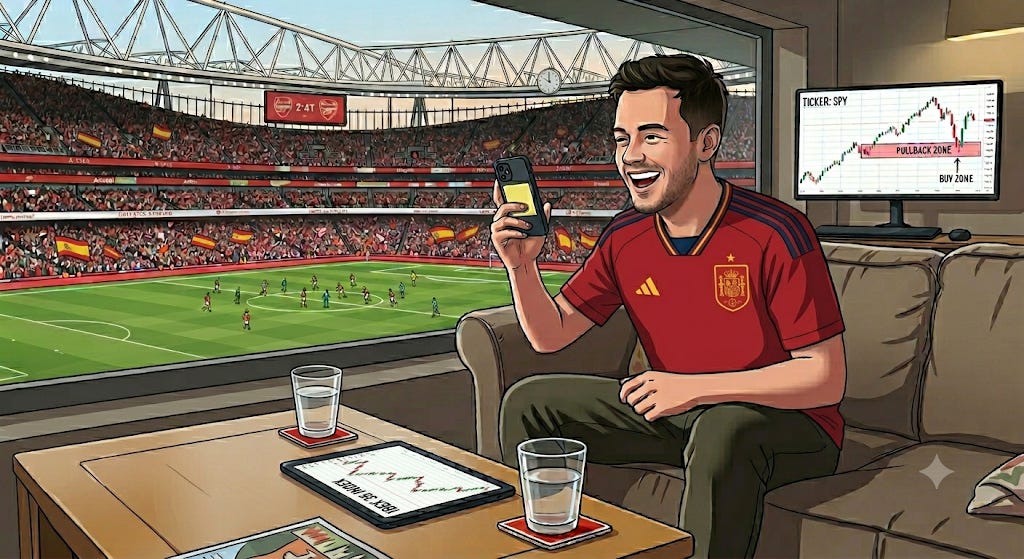
This year add the World Cup (June 11 through July 19, hosted in the US). You’re watching a match, you glance at the app between halves, ES is down 30 handles, you panic-sell into what turns out to be the low. Every push alert is an invitation to skip your process.
3. Afternoon tilt.
Our data shows tilt peaks between 12 and 3 PM. Not sometimes. Consistently, across years of logged calls.
The morning session is where real price discovery happens. Institutional flow, earnings reactions, macro prints. After lunch, the character changes. Liquidity thins out, algo-driven mean reversion takes over, and the 0DTE crowd starts gambling into the close. The afternoon isn’t the same market you prepped for at 9 AM. You’re playing a different game with different participants, and most discretionary traders don’t adjust for that.
If the morning thesis didn’t work, the afternoon won’t fix it. Some of our best weeks came from doing nothing after lunch.
The catch: in a global, 24-hour market, the best setups don’t always show up on your schedule. The overnight session gaps, the European open sets a level, or a dip triggers at 2 AM while you’re asleep. That’s the tension with stepping away. The solution isn’t to watch more. It’s to prep more. Do the work upfront. Know your levels, set your alerts, define your trades before the move happens. If you’re running a system, this is where it earns its keep. The prep is the edge, not the screen time.
4. Assuming “summer is quiet.”
This is positioning, not fact. Low liquidity plus crowded positioning equals amplified moves on any real catalyst. And with 62% of volume in same-day options, every move becomes a feedback loop. Selling triggers more selling, faster.
Summer 2024 proved this. Indexes hit their 38th all-time high in July. Three weeks later, a soft jobs report and mega-cap earnings misses triggered an 8.5% drawdown. Anyone who chased mid-July with no exit plan gave back months of gains in days.
The question PTJ would ask: what’s my defense if this gets disorderly? If you don’t have a clear answer, your size is too big.
5. Flip-flopping in a range.
Long, stopped, short, stopped, long again.. three direction changes in one session means you are the risk, not the market. 0DTE makes this cheaper per trade but more addictive. You can flip-flop 10 times in a day and each one feels small. The cumulative damage isn’t. When you look back at your worst months, they won’t be the ones with one big loss. They’ll be the ones with 30 small ones that added up while you weren’t counting.
Hard rule that’s saved us more money than any indicator: three flips and you’re done.
6. Becoming the counterparty.
The behavioral mistakes above don’t happen in a vacuum. They happen inside a market structure that’s designed to exploit them.
Jane Street made $16.1 billion in trading revenue last quarter. 60-75% of all equity volume is algorithmic. These are systems designed to exploit predictable behavior at nanosecond speed.
But an ex-Jane Street quant taught us something that changed how we think about this: your edge isn’t defined against the best player. It’s defined against the marginal participant. And in summer 2026, the marginal participant is checking their phone at the pool doing zero analysis. An NBER study found the median retail trade gets 6 minutes of thought. Six. You spend 6 hours prepping on a Sunday. But when you force a boredom trade on a slow Tuesday afternoon, you’re making the same kind of decision as the person who spent 6 minutes. All that prep, abandoned in one impulsive click.
7. Trading outside your lanes.
Nothing to do in your core names.. so you start dabbling in crypto, meme coins, whatever’s moving on the timeline. Every drawdown we’ve had traces back to this. The people posting gains are showing their winners. They’re not showing the other four positions that bled out.
8. Chasing new highs without a plan.
New highs aren’t bearish. Buying at record highs has historically outperformed buying on random days. The mistake isn’t being long at highs. It’s chasing extended moves with no pullback plan.
At new highs in a quiet summer, your entry matters more than your direction. A 3% dip gives you a dramatically better entry with real structure underneath it. Last summer’s 8.5% flush proved the distinction. Don’t be a pig. If the first half was generous, wait for the fat pitch.
9. Ignoring regime changes.
Summer hides real transitions. Q2 earnings reshape leadership. The winners from the first half start fading while the laggards quietly rotate in. Last summer the mega-cap to small-cap rotation happened fast and most people missed it.
When the correction comes, you need to know which kind: wrong (crystallize and move on) or disagree with price action (lean in and build). That distinction is worth more than any indicator. If your signals conflict and you can’t classify the regime cleanly, get smaller. For system runners, that means reducing allocation or pausing entirely, not re-optimizing on the fly.
10. Not seeing the crowded exit.
What used to be groupthink among humans is now mechanical. Algorithms trained on similar data produce similar portfolios. The crowding isn’t just in ideas anymore. It’s in the plumbing. Same factor exposures, same vol-targeting models that buy when vol is low and sell when it spikes.
In January 2026, US quant funds fell 2.8% in two weeks when crowded positions unwound simultaneously. In summer 2025, momentum, growth, and quality were all trading as one factor, and when it reversed, they all reversed together. The August 2024 yen carry unwind was a $250 billion example of assets that had nothing to do with each other selling off because the same strategies were unwinding everything at once.
45% of retail now uses AI or automated tools trained on the first half’s data. When the regime shifts, they all do the same thing at the same time. For anyone watching with dry powder, that crowded exit is the entry.
The counter-playbook.
At-bat count drops. In summer, it’s 1-2 ideas per week. If the A+ setup doesn’t show up, the week is a zero.
Shutoff by noon. If the morning thesis doesn’t trigger, the day is over. But set your levels and alerts before you step away. The best summer setups often trigger at odd hours. Watch the World Cup. Go outside. Let the prep do the work.
The pullback is the trade. At new highs with thin volume, the first real dip is where the asymmetry lives. Have the levels ready. Have the size ready. Then wait.
Most of trading comes down to knowing yourself. What you’re good at, what costs you money, and having the honesty to do more of the first and less of the second.
We didn’t learn any of this from a book. We learned it from the P&L. Every summer we get a little better at recognizing the traps before we walk into them. That’s the only edge that compounds.
Have a good summer. Be safe out there.
Great one!
This is one of your best pieces, in my opinion. You exquisitely capture the essence of a typical market participant. It should be printed out, framed, and placed on the desk of every participant. Well done.