

I didn’t set out to copy Livermore.
I just kept journaling the dumb stuff I did, kept fixing it, kept tightening the loop between “that was a mistake” and “don’t do that again.”
Somewhere along the way, my process started rhyming with his. Specifally for ES (futures). Not identical. Just converging on the same hard truths.
The core idea is embarrassingly simple: price has to earn the right to be traded.
Opinions don’t get paid. Tape behavior does.
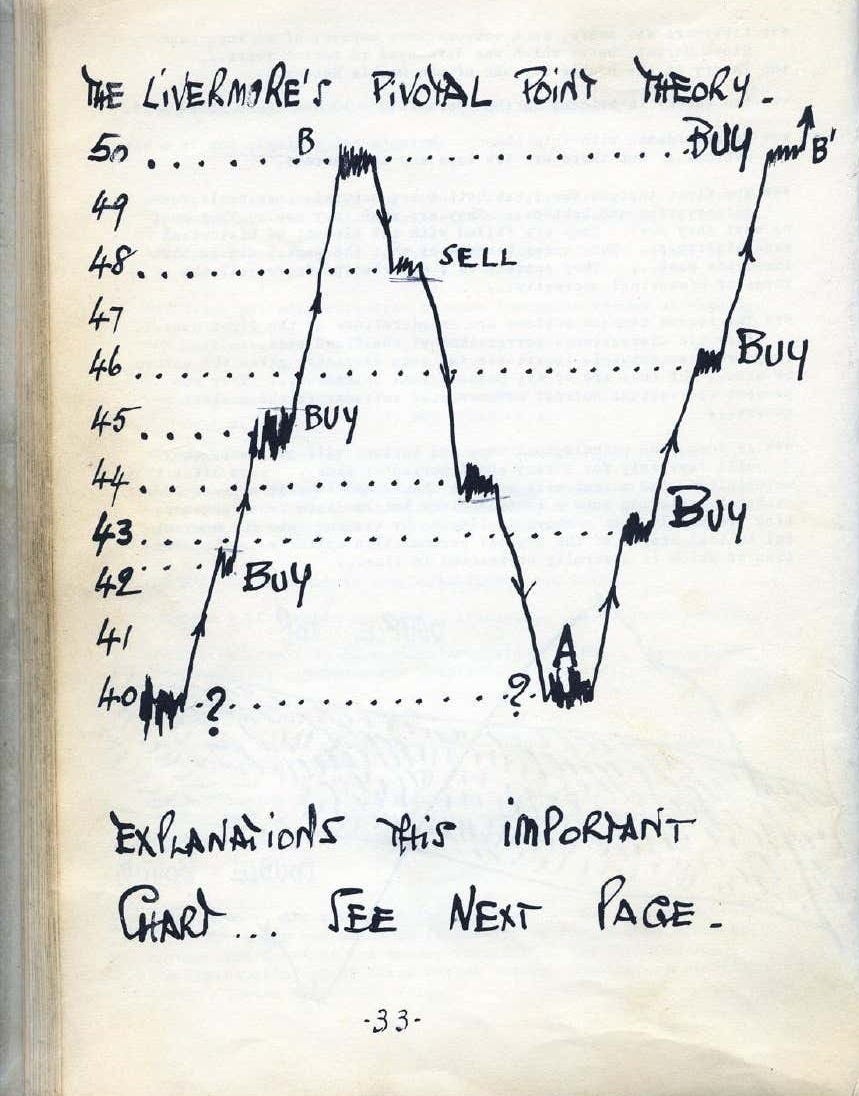
The Setup is Patience
Livermore said the quiet part out loud: markets aren’t wrong; we are.
So I mark a handful of prices that matter..yesterday’s extremes, the obvious box everyone can see, the session structure you’d be embarrassed to miss.
Then I wait.
Most days, the waiting is the work. He warned us about that, too: you can’t make money every day, and trying is the fastest way to donate your capital.
The Signal: Three Beats on the Tape
What flips the switch for me isn’t a line getting touched. It’s a moment. You know it because it has a rhythm, three distinct beats:
The Shove. A real push through the level. Not a timid peek, but a move with actual range and pace that gets your attention.
The Breath. A calm check-back to the level. This is the test. It can’t unwind the entire move; it has to hold, showing acceptance of the new price.
The Answer. A clean resumption of the trend that says, “Yes, that was the real deal. This is the next leg.”
If I get those three, the trade earned its risk. If I don’t, I stand down and let someone else play hero in the chop.
Confirmation Isn't a Suggestion
Livermore wanted proof. Not a tick. Not “almost.” He demanded price carry beyond the last pivotal point by a clear margin.
If the market refuses to do the obvious thing at the obvious spot, that refusal is the information. Believe it faster.
He also separated “normal” from “danger.”
Normal is a thrust, a smaller pullback, and a new high or low. It’s the market breathing.
Danger is a breakout that immediately goes nowhere, followed by a violent slap in the face.
You don’t argue with danger. You leave.
The Math of Survival: Sizing and Pyramiding
This is where most traders turn a good idea into a bad month.
Livermore’s trick was to probe..a small, exploratory bet that only grows if the market proves you right first.
I treat my first entry as a scout. It gets a fixed slice of risk..call it 1% of the account. The size is tiny, maybe 20-25% of my full intended position.
I do not add unless the probe is green.
I do not add inside the pullback.
I add after the resumption, when the market proves the pullback wasn’t a reversal.
After every add, I pull the stop forward behind the last clean pause. The original risk has to die quickly. This is the math of survival: losers stay small; winners grow on the house’s money.
A Trade in the Life
Let’s make it real. You’ve got a $100,000 account.
Your max risk on this idea is 1.5%, or $1,500. ES has been grinding up, now compressing in a tight box: 5,900 to 5,940. Everyone sees the lid at 5,940.
The Shove: Price breaks 5,940 with authority.
The Probe: You enter with two contracts at 5,941. Your stop goes at 5,926. That’s 15 points of risk. (15 pts×$50/pt×2 contracts=$1,500). The entire idea’s risk is on your smallest size. This is the key.
The Proof: Price runs to 5,965 and takes a breath. The tape said yes.
The Add: On the resumption, you add three more contracts at 5,966. You immediately pull the stop for all five contracts up to 5,945, just above your original entry. Your risk is now off the table. You’re playing offense with a seatbelt on.
The Pyramid: The trend continues. After the next clean pause and resumption near 5,990, you step into your full size. The stop for the entire position comes up to 5,970.
You’re now in the spot Livermore lived for: big when right, protected when wrong. You weren’t smarter than anyone. You just demanded proof before committing size.
When the Story Changes, You Leave
The market does what it does: it surprises you. The next day opens hot at 6,050 and then gets punched in the throat—a fast, seventy-point flush into the close.
That is not a “healthy check-back.” That is abnormal behavior.
Livermore would have been flat before the prayer candles came out. Me too. Somewhere around 5,980, the campaign ends. You bank it and you leave.
There’s a discipline most traders skip here: pull a piece of the profit out. Transfer it. Make it real. He did this to keep his head right. It still works.
The Playbook on a Post-It Note
This whole sequence is just a business process with a few simple laws:
Price must earn the trade.
The first piece is a question, not a claim.
Add only to strength, after the resumption.
Move the risk forward relentlessly.
Exit the moment behavior turns abnormal.
If you trade something that isn’t ES, the rules don’t break. The instruments change. The human behavior around meaningful prices doesn’t.
The Mistakes vs. The Fixes
The mistakes are always the same. The fixes are boring and powerful.

And write it down. Not how you felt…what the behavior actually did. Impulse distance, pullback depth, resumption strength, result. Do that for two weeks, and you’ll recognize the shape of your A+ setups.
Livermore’s real edge wasn’t magic. It was emotional discipline: sit with size when the market proved him right, and step off the train the moment it stopped behaving.
That’s still the job.
If you need a one-liner to carry in your pocket, make it this:
Make price earn the trade. Start tiny. Add to proof. Move the risk forward. Sit when it behaves. Leave when it lies.
Everything else is decoration.
p.s. I post daily ES levels in chat.. this is how i trade ES. Ideally soon to be automated :)

Excellent post! Much appreciated for sharing such perspectives on the process 🙏
Thanks for sharing. Good insight.