

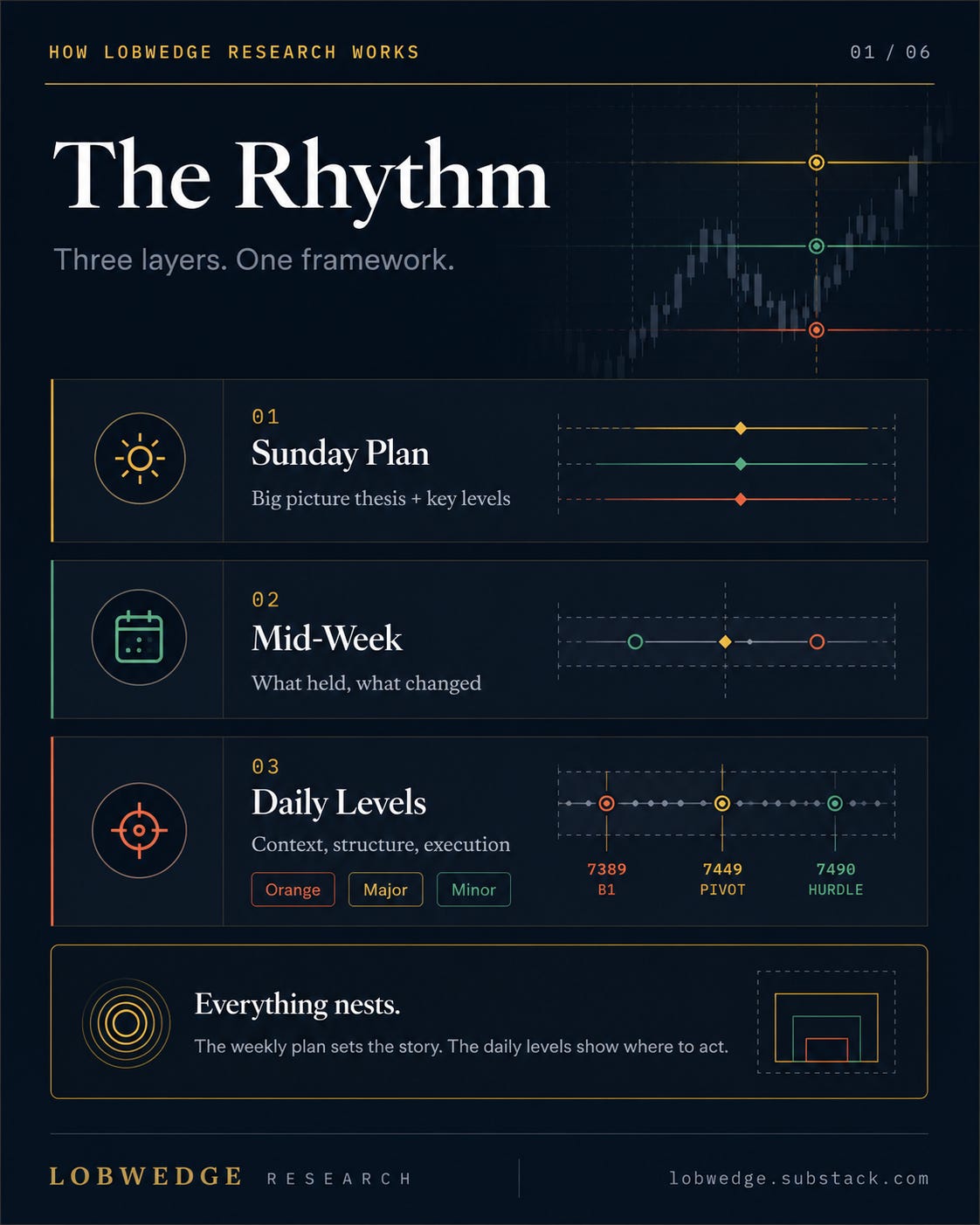
The Rhythm
Sunday Plan — the main event. Regime read, key ES levels, sector leadership, and the game plan for the week. The strategic map.
Mid-Week Update — Wednesday check-in. Did the thesis hold? New levels, updated lean.
Daily Levels — for active traders, three flavors:
Orange — high-conviction context zones. Expect a test, watch the reaction. Clearing one tells you the tape’s intent.
Major — structure that frames the session.
Minor — scalp zones for entries, exits, and intraday risk.
Everything nests. The weekly plan tells the story; the daily levels tell you where to act within it.
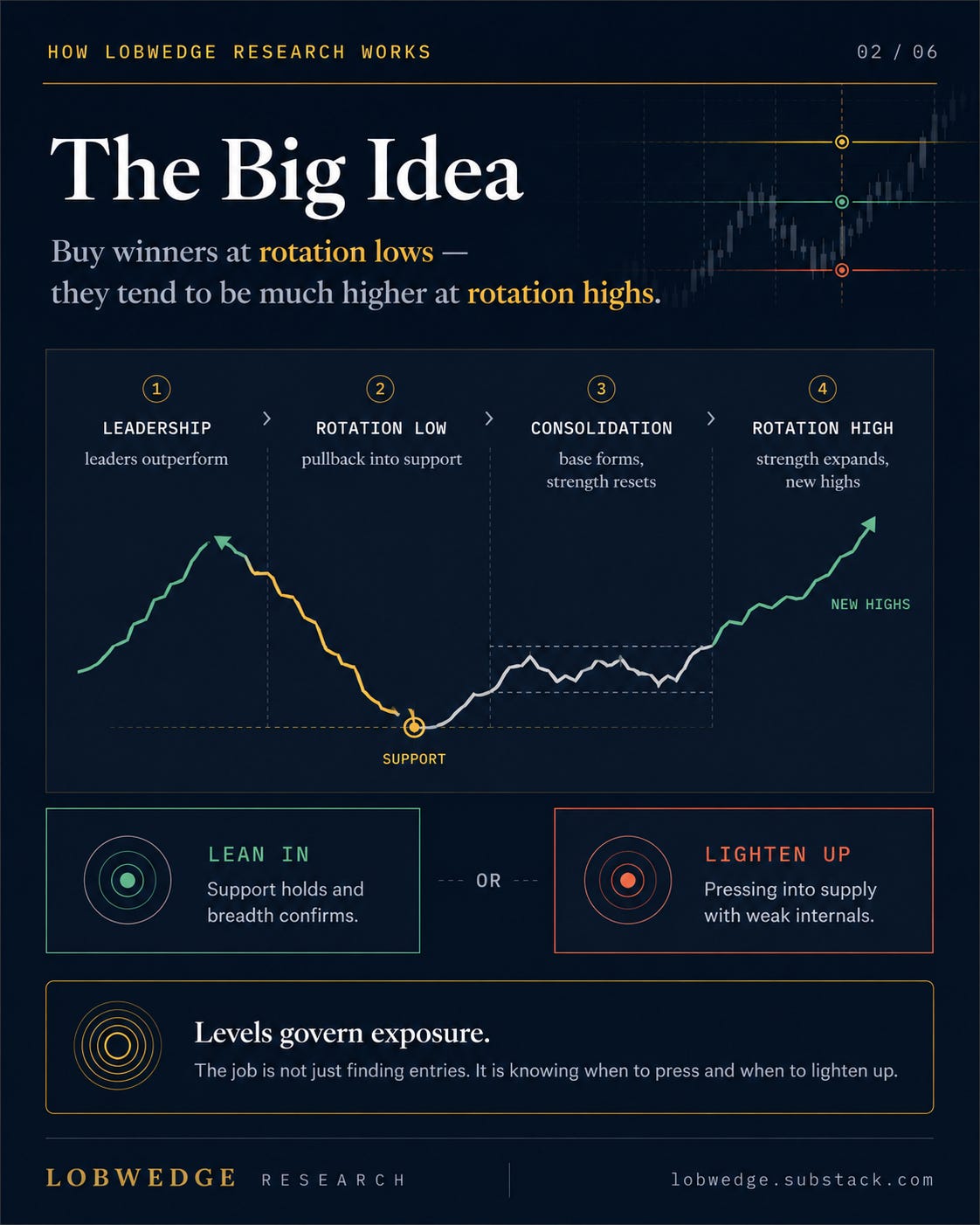
The Big Idea
Buy winners at rotation lows — they tend to be much higher at rotation highs.
Markets rotate. Leaders pull back, consolidate, resume. We identify structural leaders and add exposure when they dip into defined zones. Levels also govern exposure: support holds and breadth confirms → lean in. Pressing into supply with weak internals → lighten up.
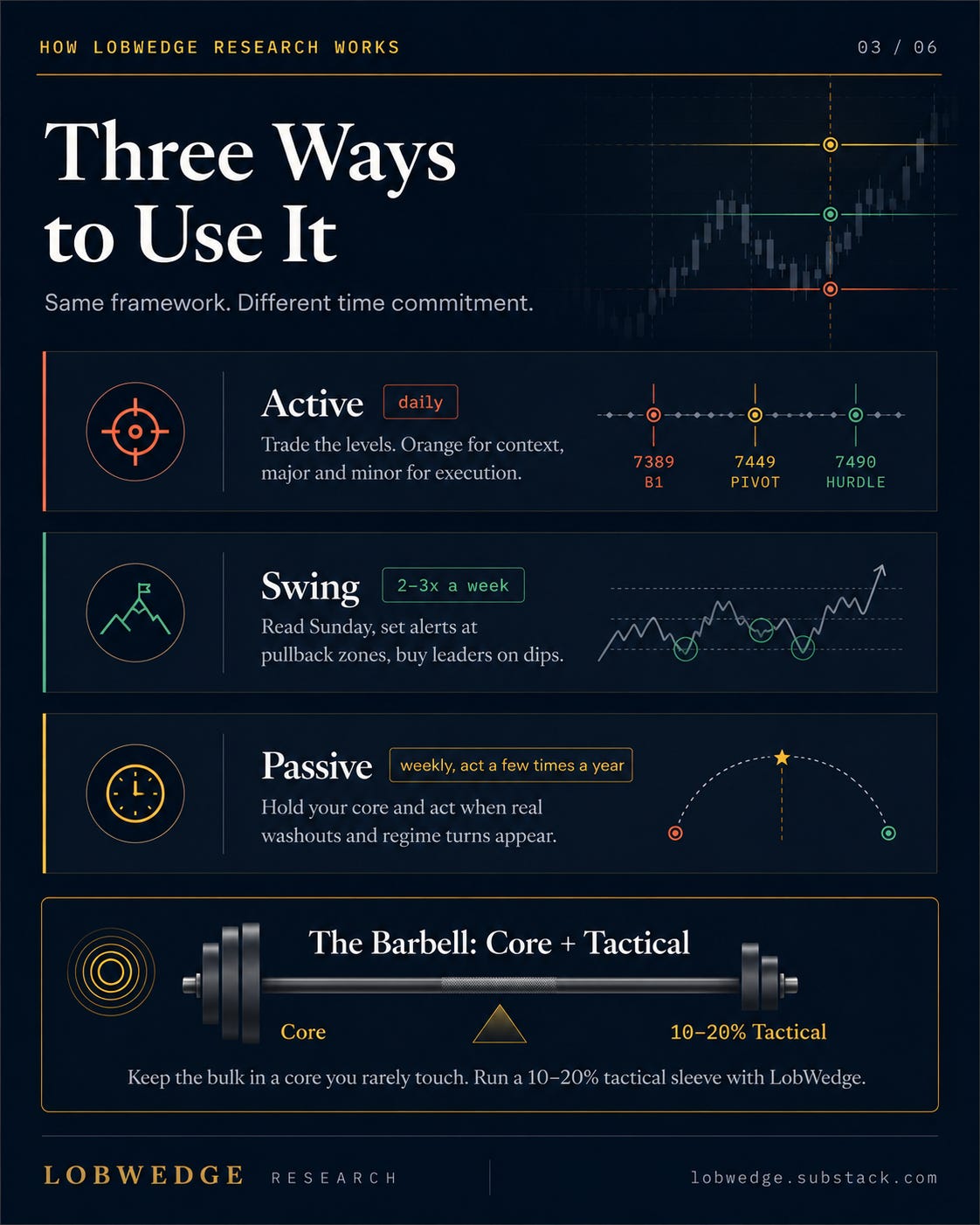
Three Ways to Use It
Active — daily. Trade the levels: orange for context, major/minor for execution. The weekly plan keeps you on the right side of the tape.
Swing — 2-3x a week. Read Sunday, set alerts at the pullback zones, buy leaders on dips. Options for overnight risk — defined risk, no 3am margin calls — or just ride the leaders.
Passive — weekly, act a few times a year. The biggest money is made 1-3 times a year, not 1-3 times a week. Real washouts and regime turns are rare — our models flag them. Read Sunday, hold your core, and be ready with cash when the fat pitch comes. The rest of the time, you get your time back.
The Barbell: Core + Tactical. Keep the bulk in a core you rarely touch. Run a 10-20% tactical sleeve with LobWedge: buy dips into defined zones, press at flagged lows, sit in cash when the tape is unclear. Tactical upside without betting the book.
In Practice
Take this spring’s five-week slide — VIX above 30, sentiment at washout.
The beginner ignored the daily levels. The weekly plans kept saying: tape unclear, no reason to be a hero. She sat in her core — that was the trade. When the washout flagged and the turn confirmed, she bought the leaders in fifths over several sessions. One decision window, executed calmly.
The advanced trader worked the whole move. Mid-week flagged 6,680 as the hurdle; it rejected three times, so he stayed small and short-biased off the orange levels. At the washout signal he flipped — options at the turn, then pressed leaders as breadth confirmed.
Same signals. Neither forced trades in the unclear stretch, both scaled in, both acted when the framework said the edge was real. The difference is time spent, not process.
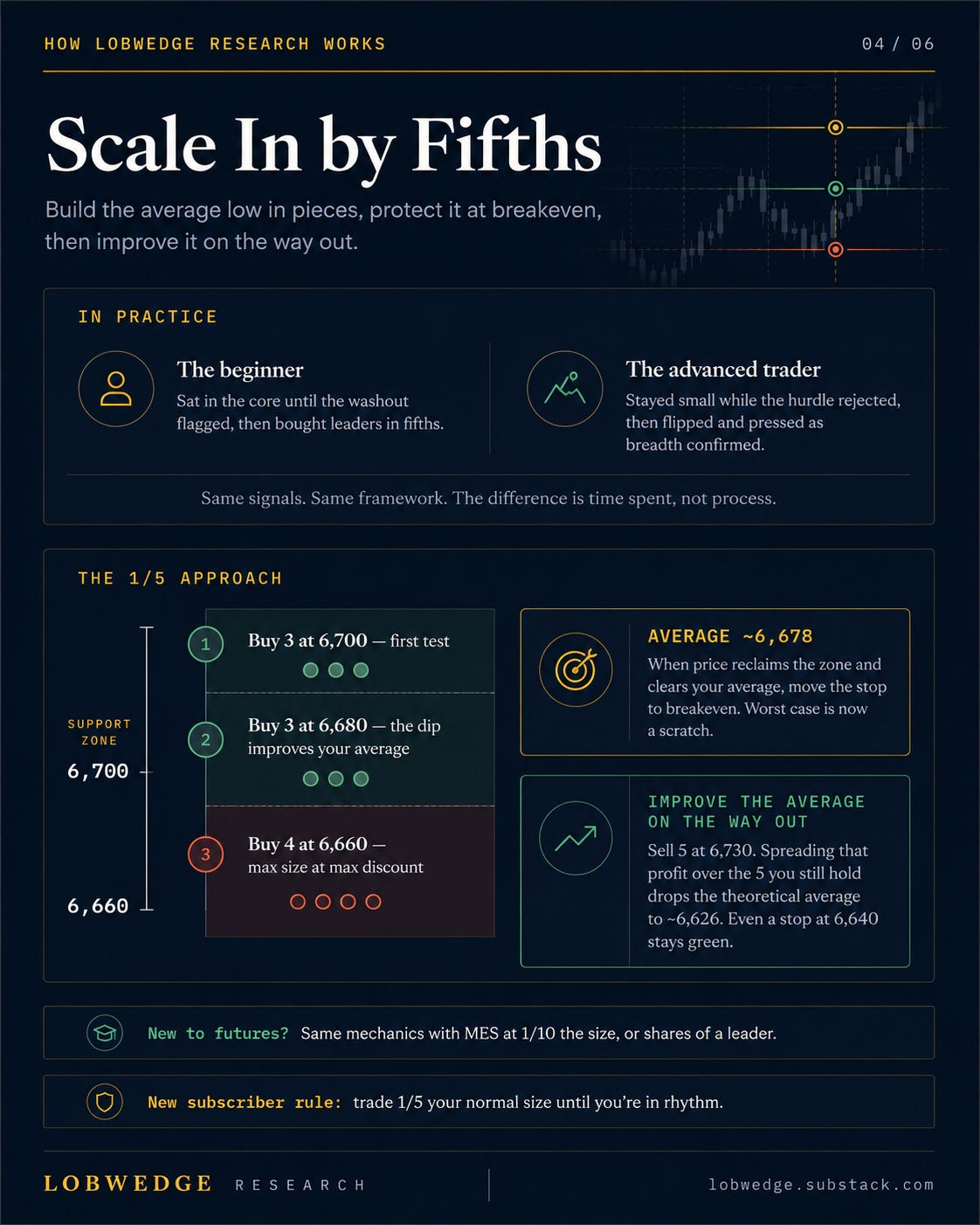
Scale In: The 1/5 Approach
Nobody nails the low — you don’t need to. Split your intended size into fifths and build it.
Support zone 6,700-6,660, plan is 10 ES:
Buy 3 at 6,700 — first test
Buy 3 at 6,680 — the dip improves your average
Buy 4 at 6,660 — max size at max discount
Average: ~6,678, near the zone low, no hero entry required. When price reclaims the zone and clears your average, move the stop to breakeven. Worst case is now a scratch.
Then improve the average on the way out. Price reaches first resistance at 6,730 — sell 5, banking +52 points each. That profit belongs to the position: spread it over the 5 you still hold and your theoretical average drops to 6,626 — below the entire support zone. Even a full stop-out at 6,640 leaves the trade green. The remainder rides toward the bigger targets carrying zero risk.
That’s the full loop: build the average low in fifths, protect it at breakeven, then trim into strength so what’s left rides below cost. It works identically on the short side — cover half into weakness and the theoretical average of the rest improves the same way.
(New to futures? Same mechanics with MES at 1/10 the size, or shares of a leader.)
The same rule applies to you as a new subscriber: trade 1/5 your normal size until you’re in rhythm with the framework. There’s no prize for going big in week one.
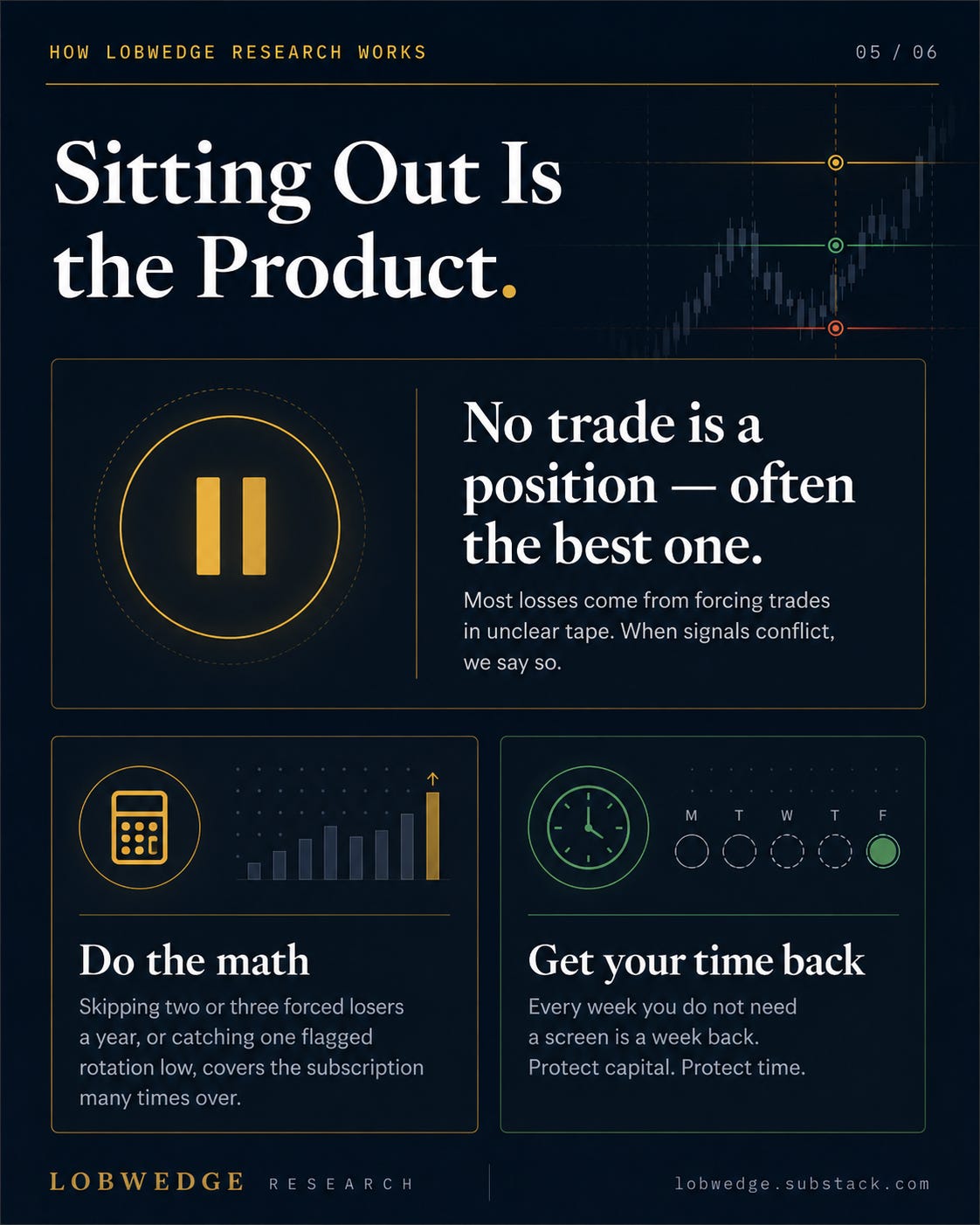
Sitting Out Is the Product
Most losses come from forcing trades in unclear tape, not from bad ideas. When signals conflict, we say so. “No trade” is a position — often the best one.
Do the math: skipping two or three forced losers a year, or catching one flagged rotation low, covers the subscription many times over. Every week you don’t need a screen is a week back.
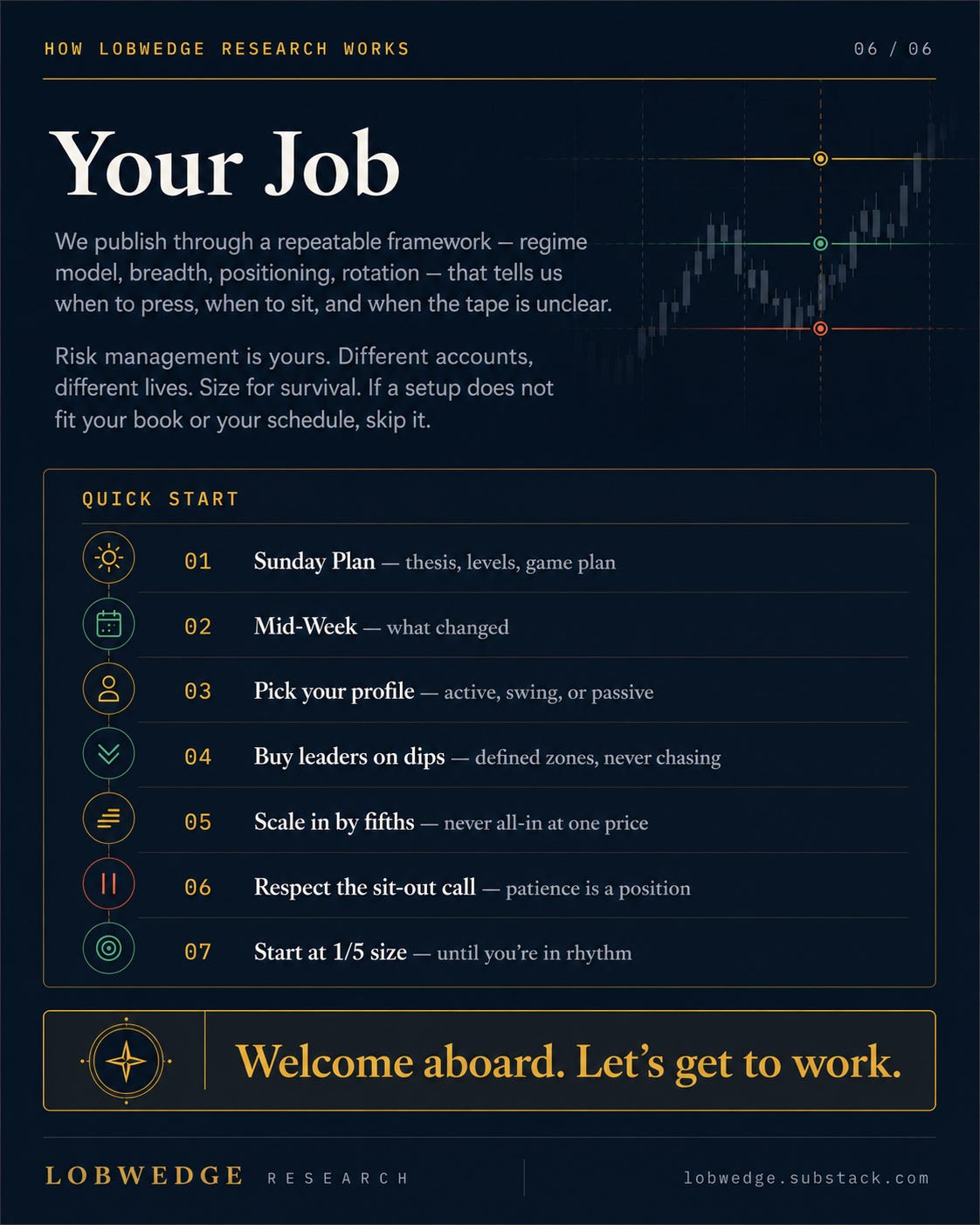
Your Job
We publish through a repeatable framework — regime model, breadth, positioning, rotation — that tells us when to press, when to sit, and when the tape is unclear. We’re not always right; we’re always systematic.
Risk management is yours. Different accounts, different lives. Size for survival. If a setup doesn’t fit your book or your schedule, skip it — there’s always another one.
Quick Start
Sunday Plan — thesis, levels, game plan
Mid-Week — what changed
Pick your profile — active, swing, or passive
Buy leaders on dips — defined zones, never chasing
Scale in by fifths — never all-in at one price
Respect the sit-out call — patience is a position
Start at 1/5 size — until you’re in rhythm
Welcome aboard. Let’s get to work.
👑
🐐