

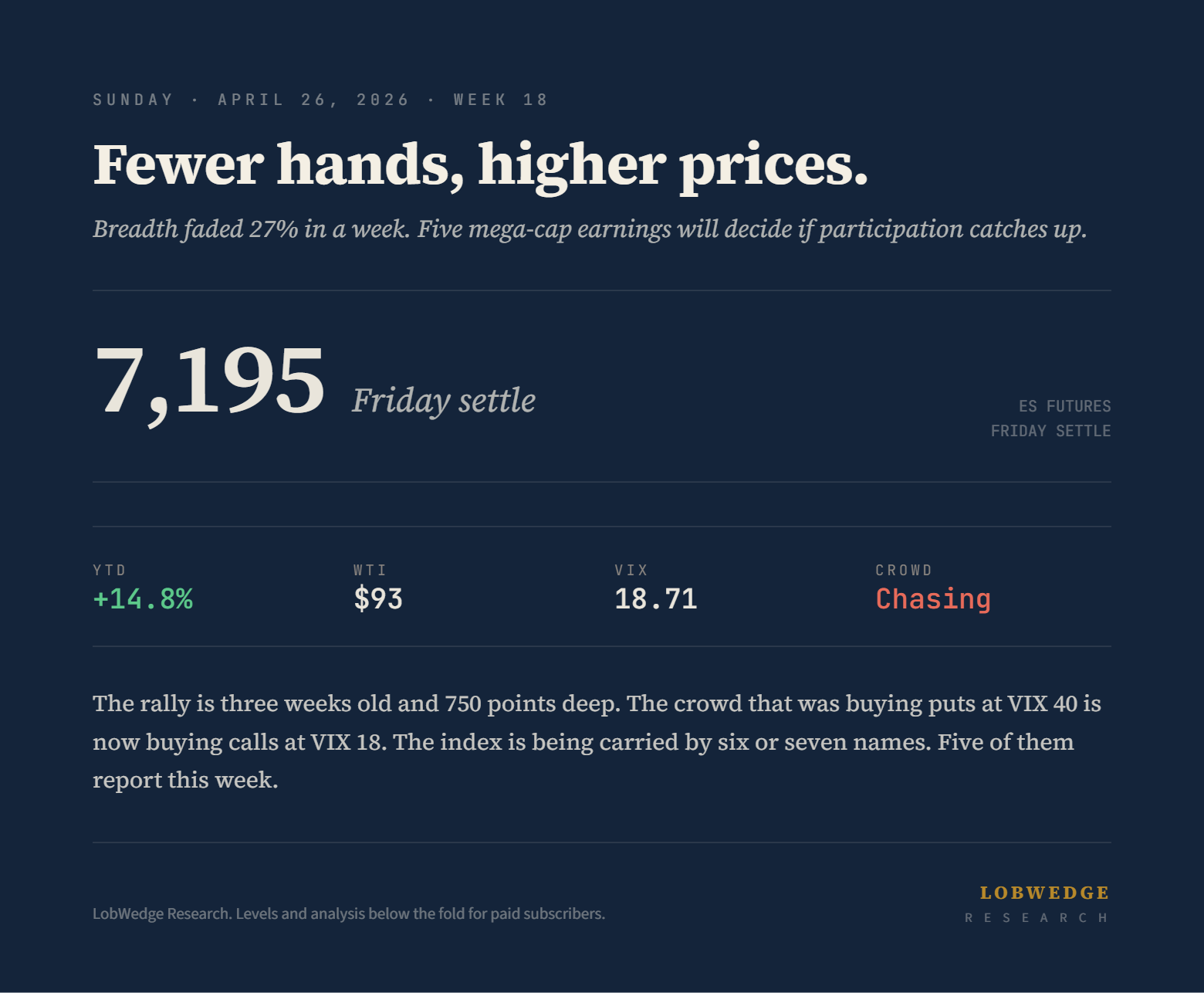
The rally is four weeks old and over 800 points deep. ES went from 6,353 to 7,195 with multiple violent pullbacks along the way, and each one was bought. Four weeks ago, the crowd was buying puts at VIX 40. Now they are buying calls at VIX 18. That rotation from fear to greed happened faster than any model predicted, and it tells you something important about positioning: the same money that was hedging for disaster is now levered for continuation.
Here is the part most people are not talking about: the number of stocks participating is shrinking while the index makes new highs. S&P 500 breadth dropped from 821 to 597 in one week, a 27% fade in participation while price added another 1.5%. The setup has echoes of past narrow rallies, including the late-cycle breadth deterioration seen around 2000, though today’s leadership has far stronger earnings quality. That does not mean the rally is over. It means the rally is getting narrow, and narrow rallies are fragile.
But this narrowing is not random. Our frameworks explain it.
The margins filter shows three themes with real pricing power: semis, AI infrastructure, and critical minerals. One is failing (software). Capital is concentrating into the names where margin expansion proves earnings quality, and leaving everything else behind.
The bottleneck migration framework tells the same story from the supply side: money is flowing toward the current constraint layer (powered shells, gas turbines, memory chips) and away from layers that already repriced.
The financial repression setup adds a third force: hard assets with supply constraints are the structural winners if the regime flips, and early positioning looks exactly like what we are seeing in energy and minerals.
Three different frameworks, one conclusion: the market is narrowing into quality, not into hope. That is the opposite of March 2000, where breadth narrowed into names with no earnings behind them.
The danger is not that the narrowing is irrational. The danger is concentration risk. Six or seven names are carrying the index. When leaders carry everything, the index behaves like a 6-7 stock portfolio, not a 500-stock basket. MSFT, META, GOOGL, AMZN, and AAPL all report this week. If they deliver, the meltup has fuel for another leg. If one misses, the index loses a load-bearing wall while the rest of the market is already pulling back underneath. Our Leaders Give Clues principle says the trend holds as long as sector leaders keep confirming. The moment they fade while ES holds highs, the divergence is structural. That is the week in one sentence: the frameworks explain why we got here, and they will tell us when to leave.
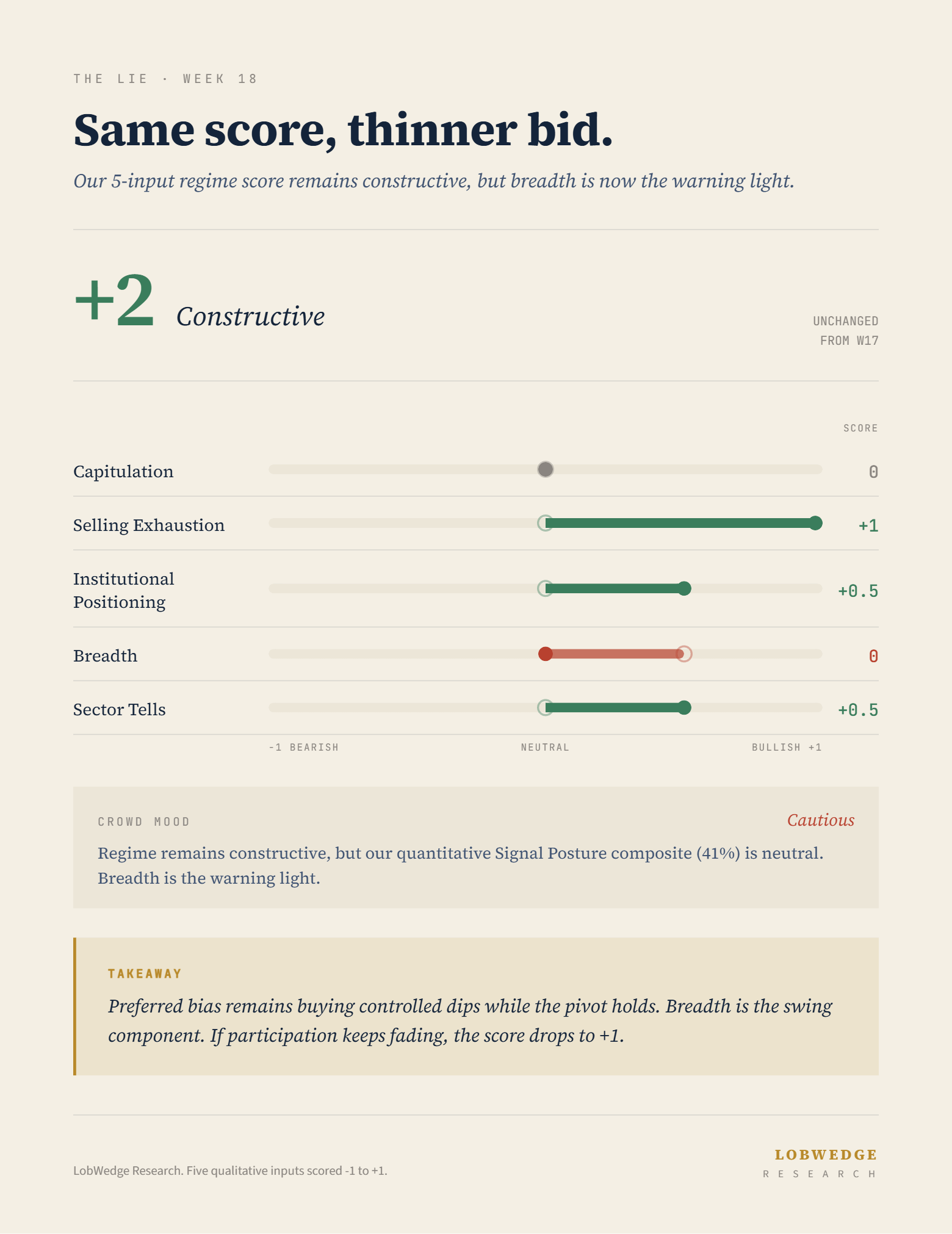
The Lie, our 5-input regime score that reads positioning, breadth, sector behavior, and exhaustion signals, stays at +2 (CONSTRUCTIVE). Was +2 last week. Our quantitative Signal Posture composite sits at 41%, neutral, neither confirming nor denying the qualitative read. The disagreement comes from one signal: new highs versus new lows dropped to its lowest quintile last week, a Q1 bearish reading. The index is making new highs while the number of stocks making new highs is shrinking. That is the breadth divergence showing up in the data. If participation stabilizes on earnings, The Lie moves toward +3. If it keeps fading, the next score is +1. Direction unchanged. Conviction a notch lower because the quant and qual are split.
Every sector that passed our margins filter in Q1 is still leading. The ones that failed are still lagging. The filter tells you which themes have earnings behind them and which are running on hope. That distinction matters more this week than any other week this quarter.
The scorecard, six levels, the high-conviction trade, and the full earnings playbook are below the fold.
