

Last week we published seven levels and wrote the kill condition for our biggest theme in plain English: an AVGO miss Wednesday. It missed. We carried defined-risk protection bought at the lowest option prices of 2026, and when the index broke its three-week pivot on Friday, that structure went to near max value. The long entry we had waiting at the pivot never set up. A one-way trend day through a level isn’t a test, so no trade. Both are graded below.
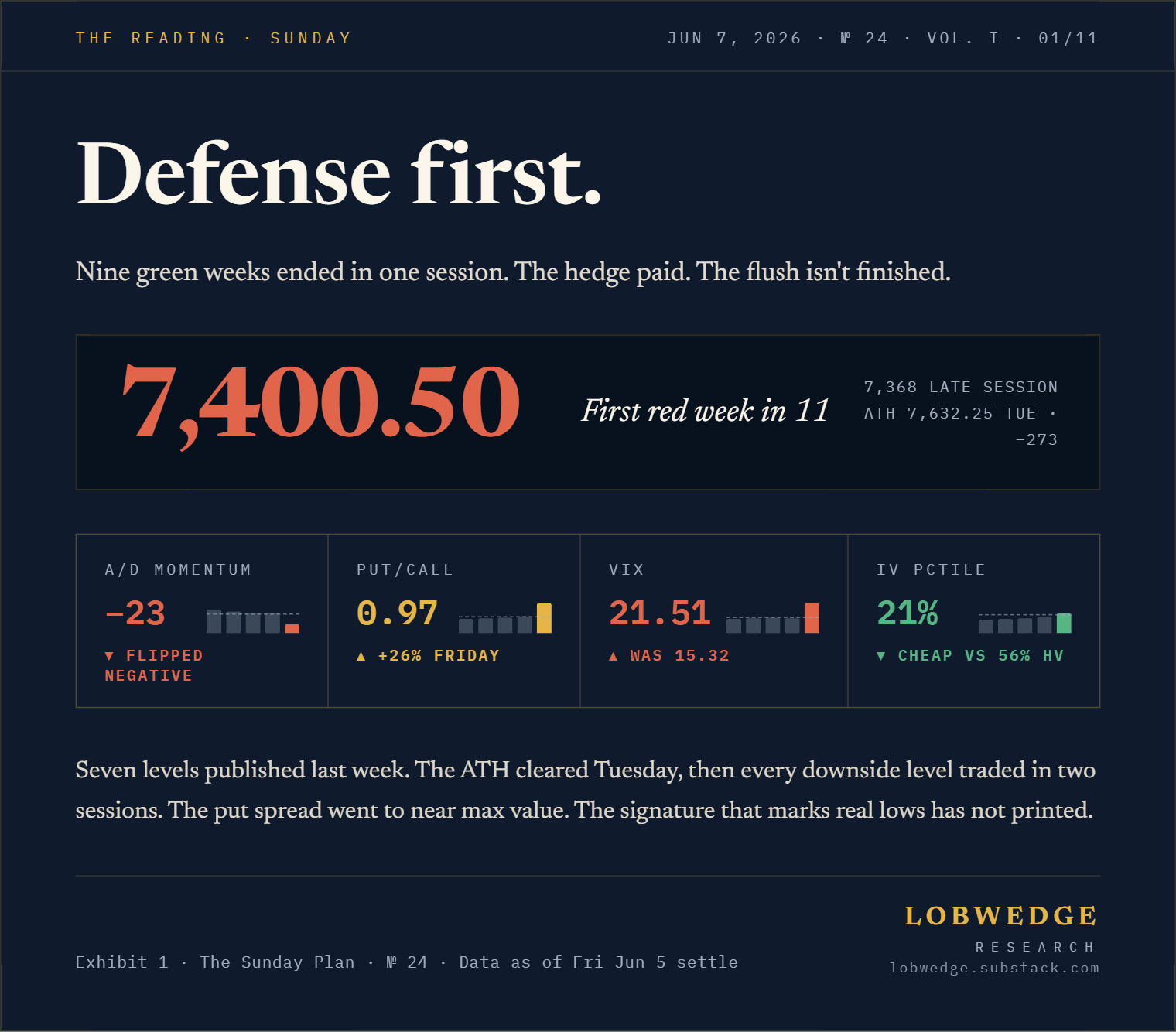
Friday was the largest one-day drop of the year. A jobs report more than double the consensus sent yields through 4.5%, and the semiconductor complex that led the whole rally fell 9.5% in a session, 10% in two days. ES settled at 7,400.50, down 273 points from Tuesday’s all-time high, and kept leaking after the bell to 7,368.
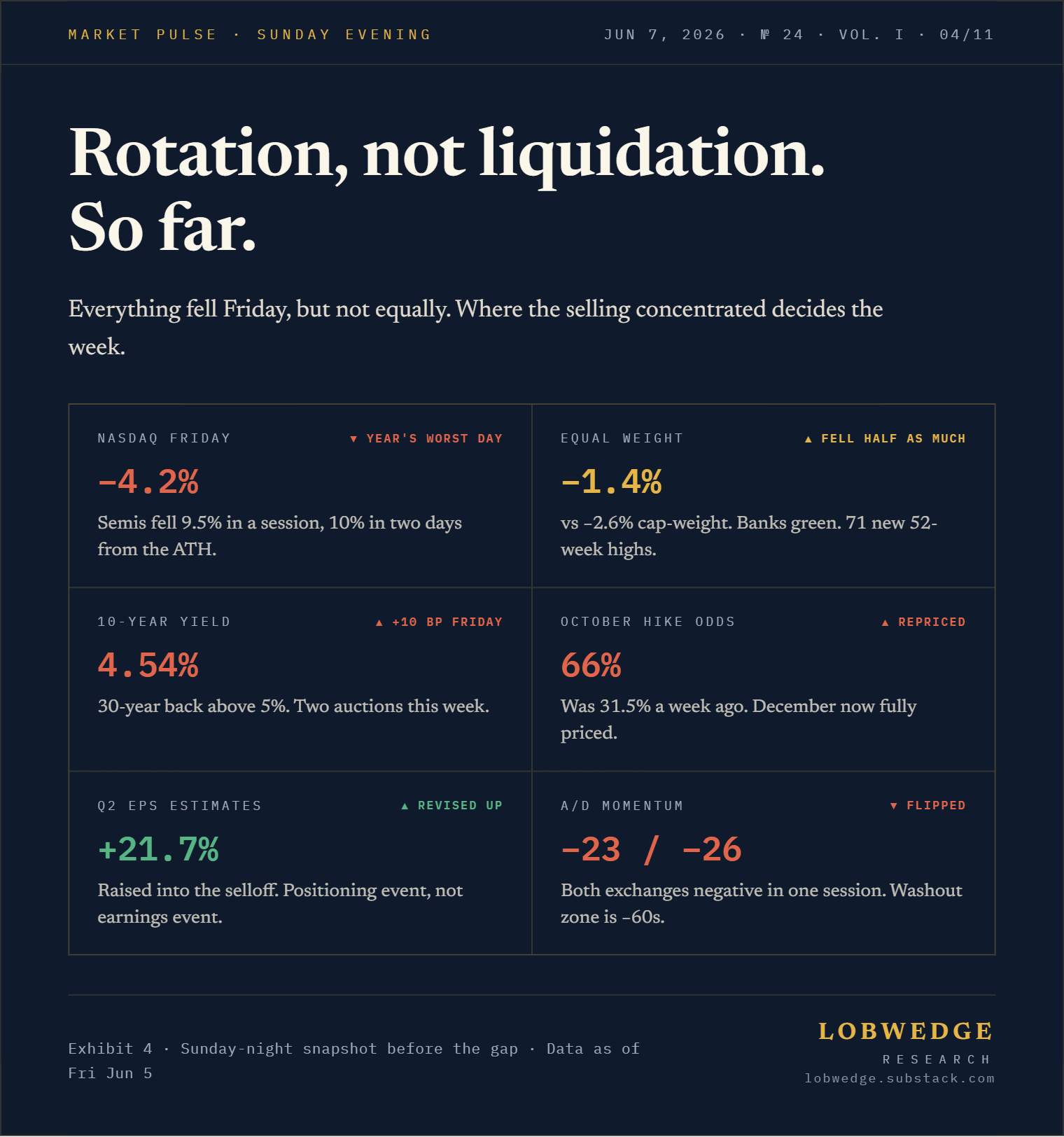
Here’s the nuance under the wreckage: everything fell, but not equally. The equal-weight index lost 1.4% against the cap-weight’s 2.6%, regional banks closed green, and 71 stocks still made new 52-week highs Friday, Apple among them. Selling that concentrated in one complex is positioning unwinding, not liquidation. At least so far.
The macro changed underneath the price. Markets now put two-in-three odds on a rate hike by October and have fully priced one by December. Six weeks ago the first hike wasn’t priced until 2027. CPI lands Wednesday with the consensus at 4.2% year over year, accelerating, and the Fed enters its quiet period with no speaker scheduled to calm anything down. The bond market votes twice this week, at Wednesday’s 10-year auction and Thursday’s 30-year auction, with the 30-year already back above 5%.
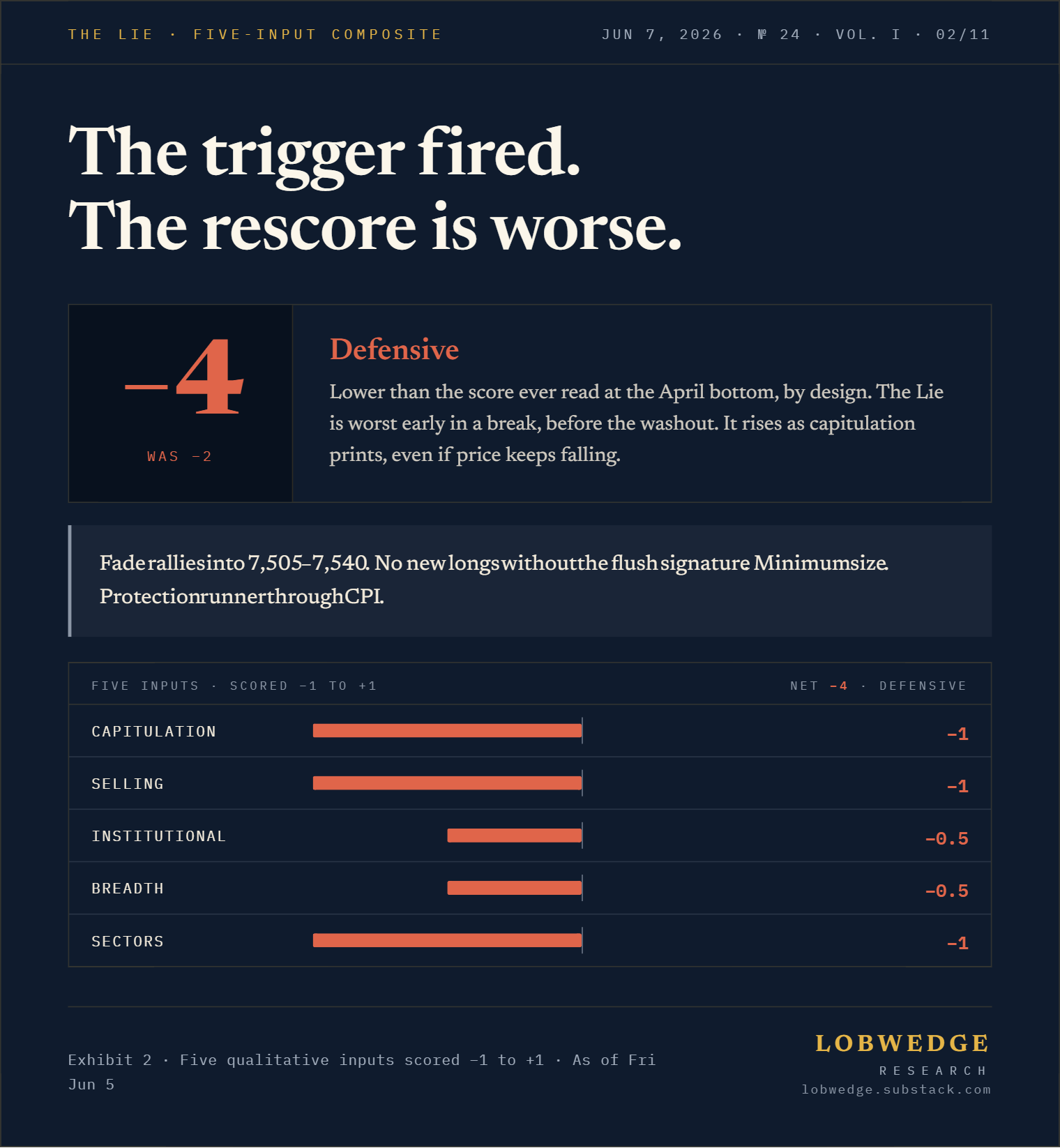
The Lie: -4 DEFENSIVE. Was -2 on Sunday. Wednesday we published the downgrade trigger in advance: a close below the pivot drops the score. Friday closed below it.
One thing about that number. It’s lower than the score ever read at the April bottom, and that’s the design, not a contradiction. The score measures how dangerous it is to be long right now. At a real low the danger has already been spent: capitulation boxes are checked, selling is exhausting, and the score is rising. Early in a break, none of that has happened yet, so the score is at its worst before price is. A falling market with a rising Lie is the buy signal. We’re not there.
One framework worth keeping from this week. Real bottoms print a signature: advance-decline momentum deep in washout territory, more puts than calls trading across the whole market, vol north of 25, and a high-volume reversal day. Friday printed none of those. Both exchanges’ advance-decline oscillators flipped negative, but they sit in the minus-20s and the washout zone is minus-60 and below. The broad put/call reached 0.97, not 1.0. That gap between “first hard down day” and “tradeable low” is why the first bounce after a breakdown usually fails. Selling gets exhausted, not scared away.
Scorecard
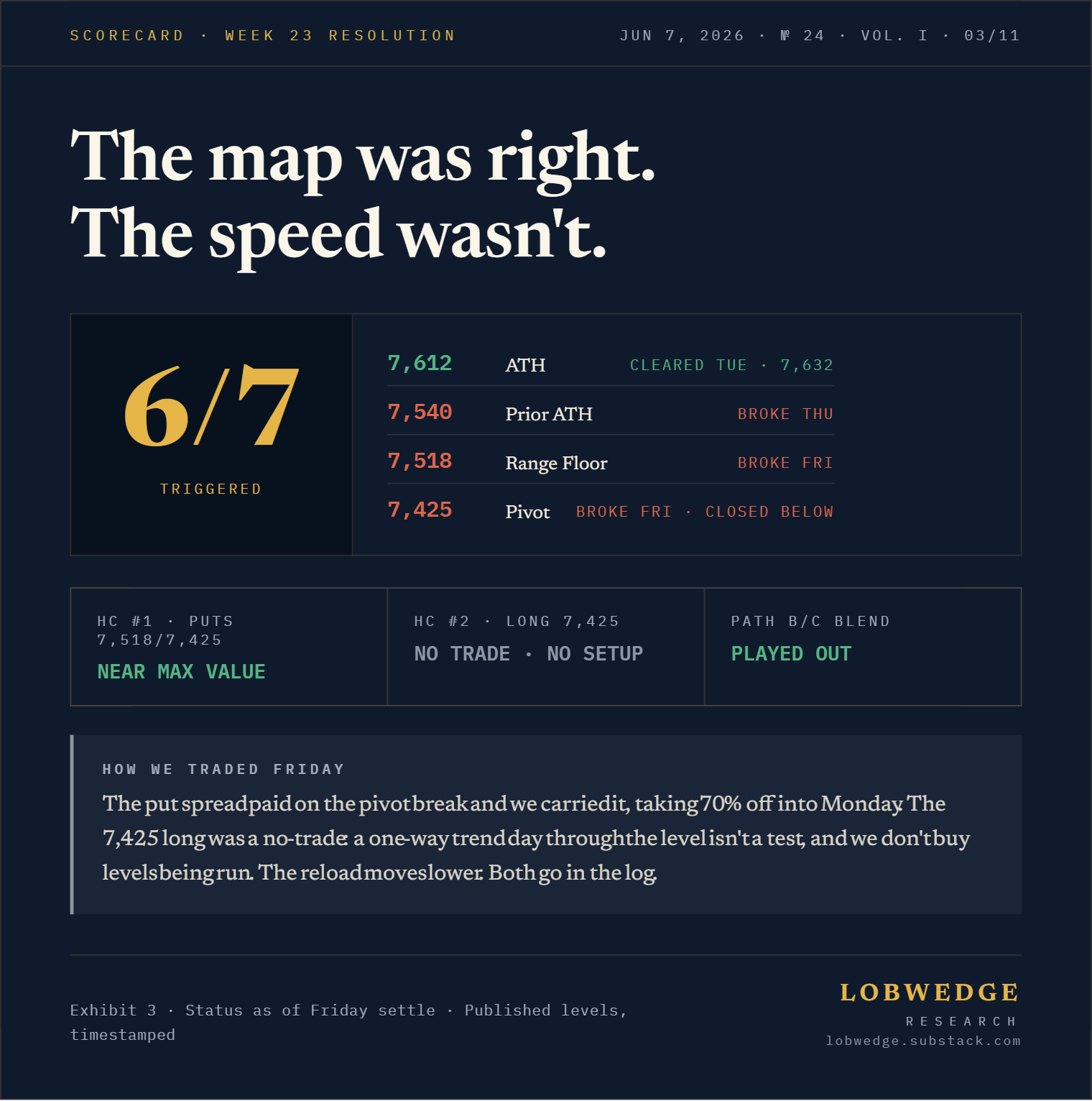
How we traded Friday, graded against what we published.
Levels. W23 published seven. 7,650 UNTESTED (high was 7,632.25). 7,612 ATH CLEARED Tuesday, new high 7,632.25. Then the breakdown: 7,600 BROKE THU. 7,540 BROKE THU. 7,518 BROKE FRI. 7,485 BROKE FRI. 7,425 BROKE FRI, closed 7,400.50. Every downside level on the map traded within two sessions. The map was right. The speed was the surprise. And the leaders gave the clue first, the semi kill condition fired Wednesday night, the index caught down Friday. Same sequence we’ve tracked since spring: leaders break before price confirms.
HC #1, put spread 7,518/7,425, June expiry. TRIGGERED AND PAID. For newer readers: a put spread is a defined-risk bet that pays as the index falls between two strikes, and the most it can ever lose is what you paid for it. We bought it when index vol sat in the low teens, published with the line “three catalysts ahead.” ES settled below the lower strike Friday. The structure is at near max value, roughly the full 93 points of width against the small premium paid when vol was the cheapest of the year. That’s the asymmetry we wrote: wrong costs pennies, right pays multiples. The plan this week: take 70% off into Monday weakness, hold the rest through CPI with the remaining value as the only thing at risk. Protection bought when nobody wants it only works if you also sell it when everybody does.
HC #2, long at 7,425. NO TRADE. The setup never formed. The published entry was a structural test of the pivot, and a test means price slows, holds, and gives you a stop to trade against. Friday gave none of that, a one-way trend day that ran the level by 66 points on the heaviest volume since March 30, the day the last correction bottomed. You don’t buy a level that’s being run. Standing aside on a trend day isn’t a miss, it’s the process working. The reload moves lower, with confirmation required.
What’s Working themes. Semis (called W13, +41% at the peak): kill condition FIRED on the AVGO guide. Stepping aside, graded and logged. Cyber (called W21, +24%): CRWD billings miss is the second crack in three weeks, which was the published break condition. Moved to fading. Space (called W14, +18%): catalyst is this week. Still holding.
What Breaks It conditions. We published two: a close below the pivot, or participation below 36%. The first triggered Friday. The published action was cut longs, double hedges, raise cash. That’s the posture this plan is written from.
Market Pulse
Six numbers below. The short version: vol woke up, the crowd finally bought protection, and the earnings engine underneath all of it is still accelerating.
The Setup
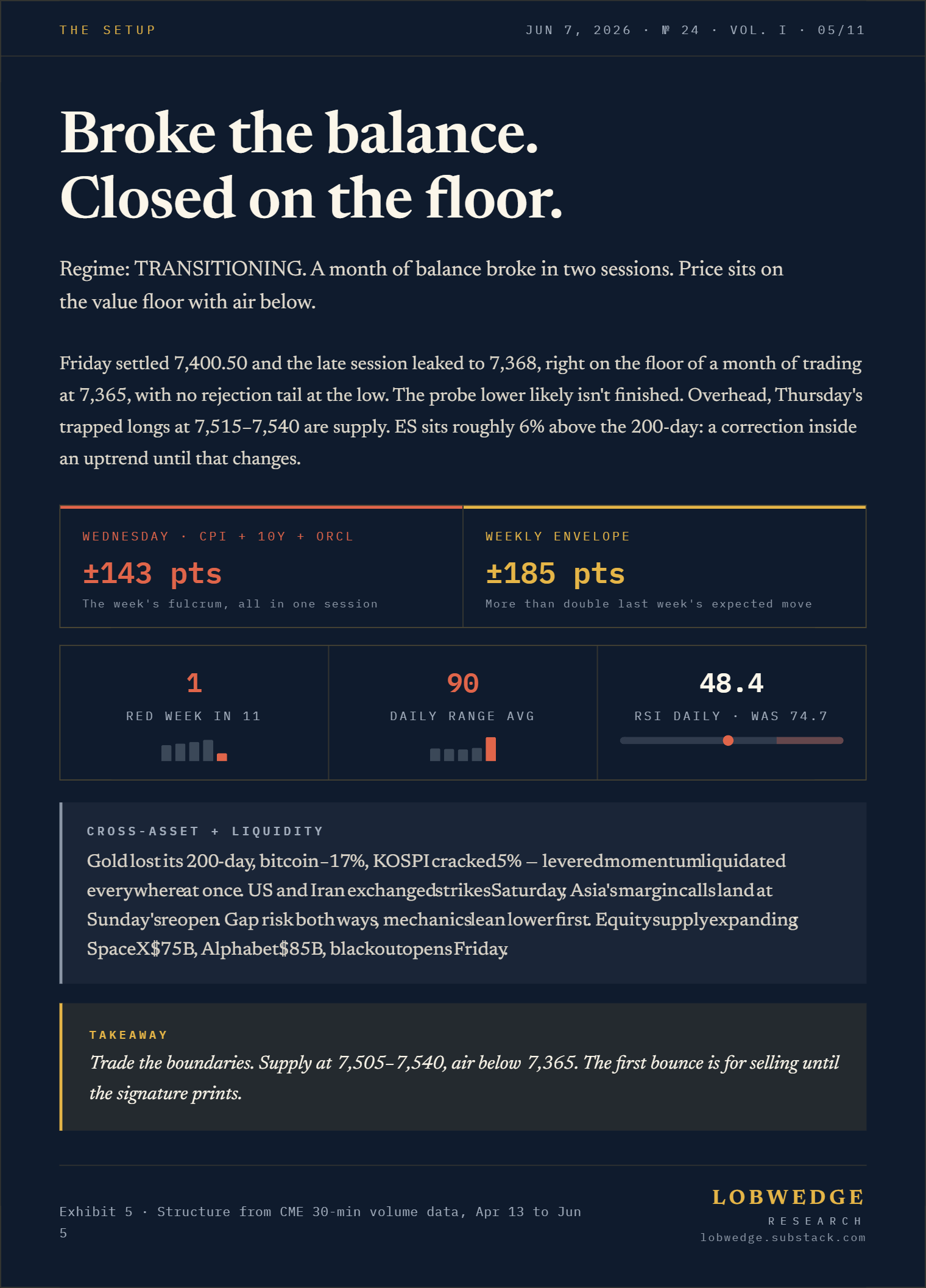
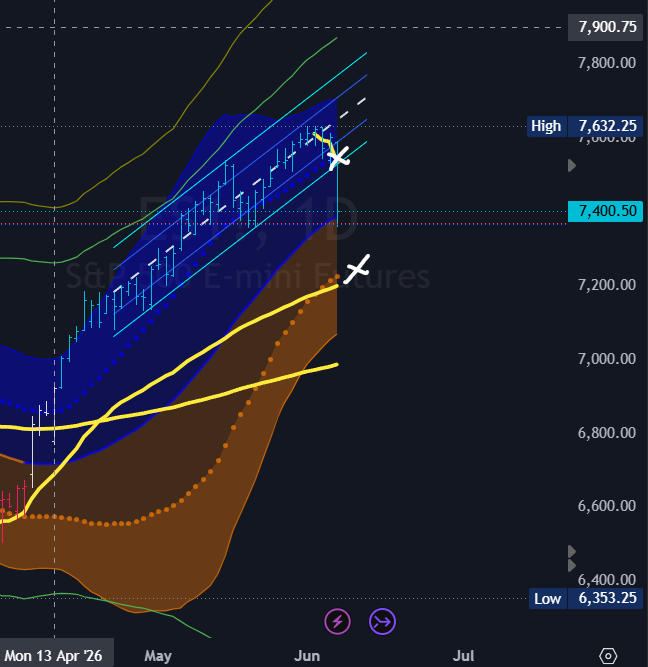
Regime: TRANSITIONING. The four-week balance broke. ES settled at 7,400.50 and the late session leaked to 7,368, which leaves price sitting three points above the floor of where the real trading happened, the bottom of the month-long range at 7,365. The playbook for a transition: respect the boundary, trade the failure. If ES breaks 7,365 and holds below it, an air pocket opens, there’s almost no volume history between there and 7,270. A reclaim of 7,425-7,440, the heaviest-traded zone of the entire structure, means the breakdown failed, and failed breakdowns are the highest-conviction long signal structure offers.
Friday left unfinished business in both directions. The session closed near its low with no rejection tail, which historically means the probe lower isn’t done. Above, Thursday’s heavy-volume shelf at 7,515-7,540 is now supply, the dip buyers who showed up a day early and want out even.
Paul Tudor Jones runs everything through one filter first: the 200-day. ES sits roughly 6% above it. This is a correction inside an uptrend until that changes, which argues against pressing shorts into holes and for selling rallies at mapped supply.
Cross-asset check: 10-year at 4.53%, up 10 basis points Friday alone. 30-year at 5.01%. Two-year at 4.15%, a 52-week high after repricing 15 basis points in a day. Bonds are not confirming any bounce until the auctions clear. And the deleveraging was bigger than stocks: gold lost its 200-day for the first time in its long uptrend, silver and bitcoin fell harder than the index, and Korea’s KOSPI, which doubled this year on the same memory-chip trade, cracked 5%. What held: banks, defensives, equal weight. Levered momentum got liquidated everywhere at once. The average stock didn’t.
Two clocks are running into Sunday’s reopen. First, Iran: the US and Iran exchanged strikes early Saturday, missiles toward the Strait answered with hits on Iranian radar sites, while Pakistan opened a mediation channel in Tehran the same day. Second, Asia: Korean and Asian accounts were closed during Friday’s US rout. Levered foreign money in US momentum names gets its margin calls when those markets reopen Sunday evening our time, and forced selling there can feed back into ES overnight. Oil in the low 90s. Sunday’s open carries gap risk in both directions, with the mechanics leaning lower first.
At 7,600 we asked the Druckenmiller question: who’s the marginal buyer when the mechanical bid fades? The answer arrived early. Buyback blackouts begin opening around Friday. SpaceX absorbs roughly $75 billion of risk capital this week. Alphabet launched an $85 billion equity raise for AI buildout and Meta followed with its own offering. Equity supply is expanding into the exact window demand goes quiet. That’s the liquidity backdrop for the next three weeks, and it leans one direction.
What’s Working and What’s Not
Levels tell you WHERE. This tells you WHAT earns the right to be bought when price gets there.
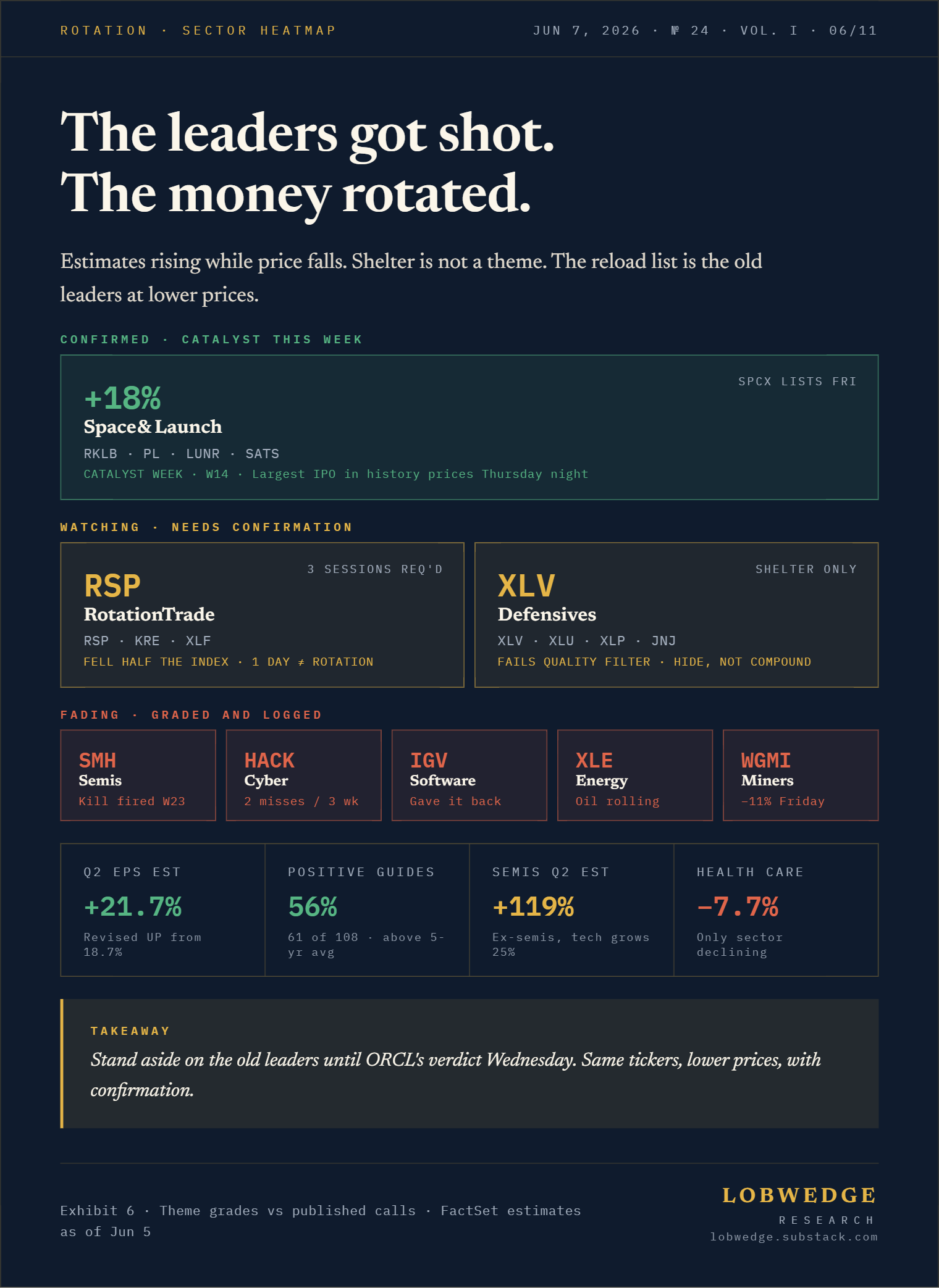
THEME: Space and Launch. Week 14 (10 weeks running). Why: SpaceX prices Thursday night and lists Friday on Nasdaq, the largest IPO in history at a $1.75 trillion valuation. Sector re-rating catalyst regardless of day-one pop or fade. Vehicles: RKLB, PL, LUNR, SATS. Status: CATALYST WEEK. Friday’s flush dragged the basket with everything else, which sets the entry. Entry zone: RKLB at the 50-day. No chase above prior week highs. What kills it: SPCX prices below range or breaks issue price in the first two sessions. That tells you the appetite for $75 billion of new paper wasn’t there. Track record: Called W14. +18% since.
WATCH: The rotation trade. Equal weight fell about half as much as the index Friday, regional banks closed green, and 71 names made new 52-week highs on a day 70 made new lows. The market is splitting, not sinking. One day is a reaction, not a rotation. Three consecutive sessions of banks and equal weight leading while semis stay heavy graduates this to a theme with entries. Not before.
SHELTER, NOT A THEME: Defensives. Healthcare, utilities, staples led Friday and J&J-type names went out green. Healthcare is the only sector with declining earnings this quarter, so it fails our quality filter. It’s where capital hides, not where it compounds.
Fading: Semis (kill condition fired, ORCL’s verdict Wednesday before any re-entry), Cyber (two misses in three weeks), Software (graduated W23, gave it all back Friday), Energy (oil rolling over on deal optimism).
One note on why memory got hit hardest. The names selling the shortage, the RAM and storage makers raising prices into hyperscaler demand, were the purest expression of the AI trade and collected the most leverage: top of the momentum rankings, 5x retail option premium, Korea’s whole index riding two of them. And the concentration is measurable: strip the semiconductor industry out of tech and the sector’s earnings growth falls from 58% to 25% (FactSet). The crowding was the risk, not the business. The business is why those names go back on the reload list once the leverage clears.
The tension in everything above: the Q2 earnings growth estimate has been revised UP from 18.7% to 21.7% since March while price just fell 3%. That’s the Tepper setup: the market is repricing positioning and rates, not survival. It becomes a buy at the right price, and the right price is lower than Friday’s close.
Risks + Policy
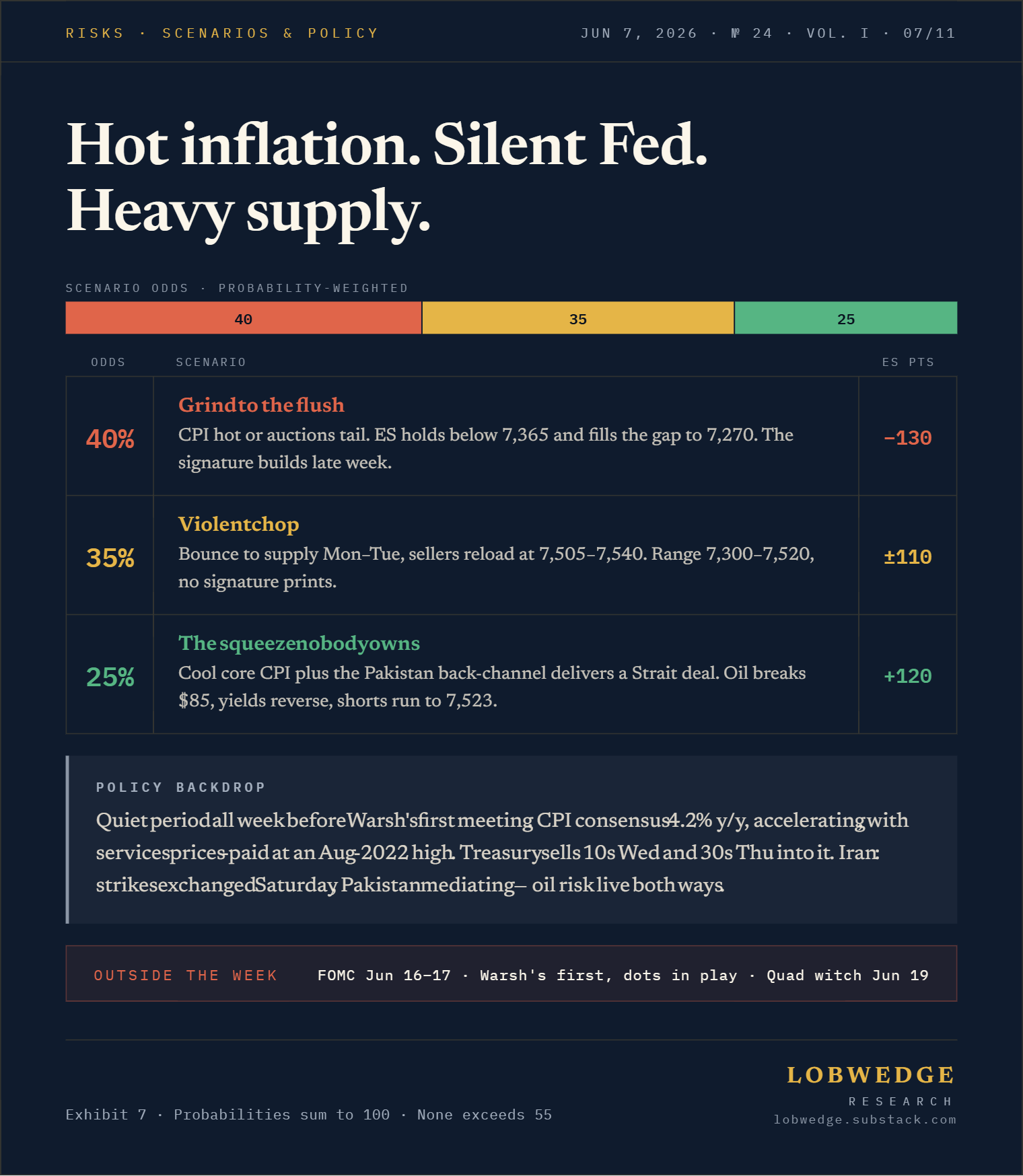
The risk this week is inflation with no safety net. CPI consensus says headline accelerates to 4.2% year over year on oil, services prices-paid just hit its highest reading since August 2022, and the manufacturing reading is still north of 80. Even the corporates are saying it: “oil” came up on 149 earnings calls this quarter, the most since early 2020 (FactSet). The Fed can’t respond, the quiet period runs all week before Warsh’s first meeting. And the Treasury asks the market to absorb 10-year and 30-year paper into the middle of it.
Bear case: CPI hot and the auctions tail, meaning demand for the new bonds comes in weak and yields jump on the result. 30-year through 5.10%. The hike repricing accelerates and ES breaks the value floor and stays below it. The air pocket to the first reload zone fills fast. The weekend made this path livelier: Saturday’s US-Iran exchange of strikes and a fraying Lebanon ceasefire put oil-spike risk back on the table into an inflation week.
Base case: CPI near consensus, auctions sloppy but absorbed. ES chops violently between the broken pivot and the reload zones, sellers reload on every bounce toward supply, and the flush signature builds toward a late-week or next-week low.
Bull case: CPI cool on the core and the diplomacy wins. The Pakistan back-channel that opened Saturday produces a signed Strait deal, oil drops 10%, yields reverse. ES reclaims the value zone and squeezes the new shorts back toward the swing high. This is the scenario nobody is positioned for after Friday, which is exactly why it pays the most per point. It’s also a weaker bet than it was Friday afternoon: strikes were still being exchanged on Saturday.
The tell: watch what defensives do on any bounce. If utilities and staples keep leading while the index rallies, the bounce is for selling. If banks and equal weight lead it, the rotation is real and the defensive lean is wrong.
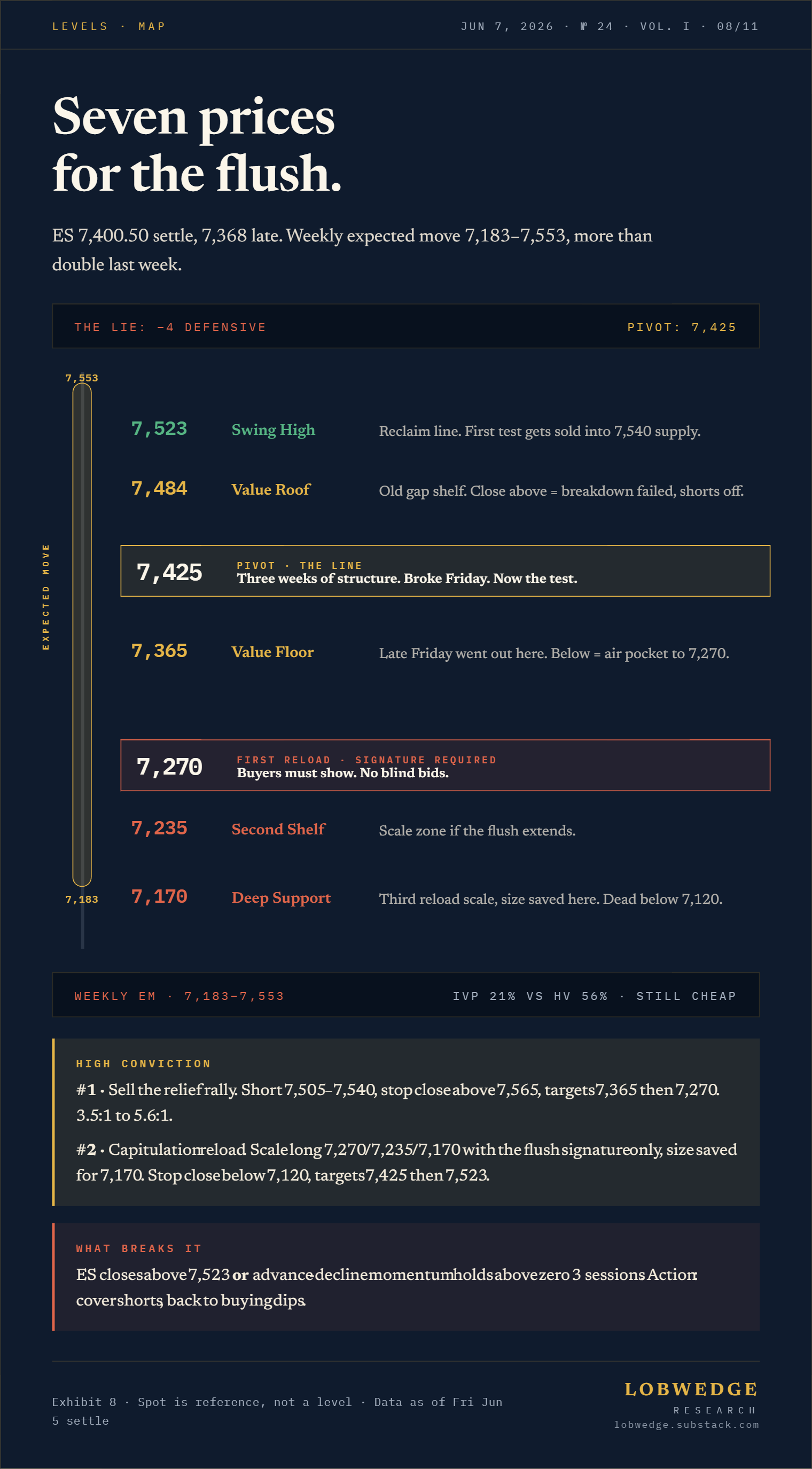
Levels
Seven prices. Nothing mystical about a level: it’s where heavy volume traded before, which means it’s where trapped buyers and patient sellers still have orders and memory. Price respects levels because people do. This week the options market is pricing a weekly range more than double last week’s, wide enough that every reload zone is in play.
7,523 Swing High. RECLAIM LINE. The level that puts momentum back on the board. First test gets sold. It sits inside Thursday’s trapped-long supply running to 7,540.
7,484 Value Roof. BREAKDOWN FAILS ABOVE. The old gap shelf from the May breakout, the first real ceiling above the pivot. A close above means Friday was a false break, shorts come off.
7,425 Pivot. THE LINE. Three weeks of structure, fair value for the entire May-June range. Broke Friday. What was support is now the test.
7,365 Value Floor. LATE FRIDAY WENT OUT HERE. The bottom of where the real trading happened, and the 7,368 after-hours print sits right on it. Holding means balance. Breaking and holding below opens an air pocket, almost no volume until 7,270.
7,270 First Reload. BUYERS MUST SHOW. The first prior-leg shelf from the April-May rally. Confirmation required, not a blind bid.
7,235 Second Shelf. SCALE ZONE. Prior consolidation fair value. If the flush extends, this is where it finds its first real volume.
7,170 Deep Support. MAX FEAR. SIZE SAVED HERE. The early-May launch shelf, just below the weekly expected move. The third scale of the reload and the biggest one. If it trades here this week, the capitulation checklist will be lighting up. Below 7,120 the shelf is broken, the reload is dead, and we stand down.
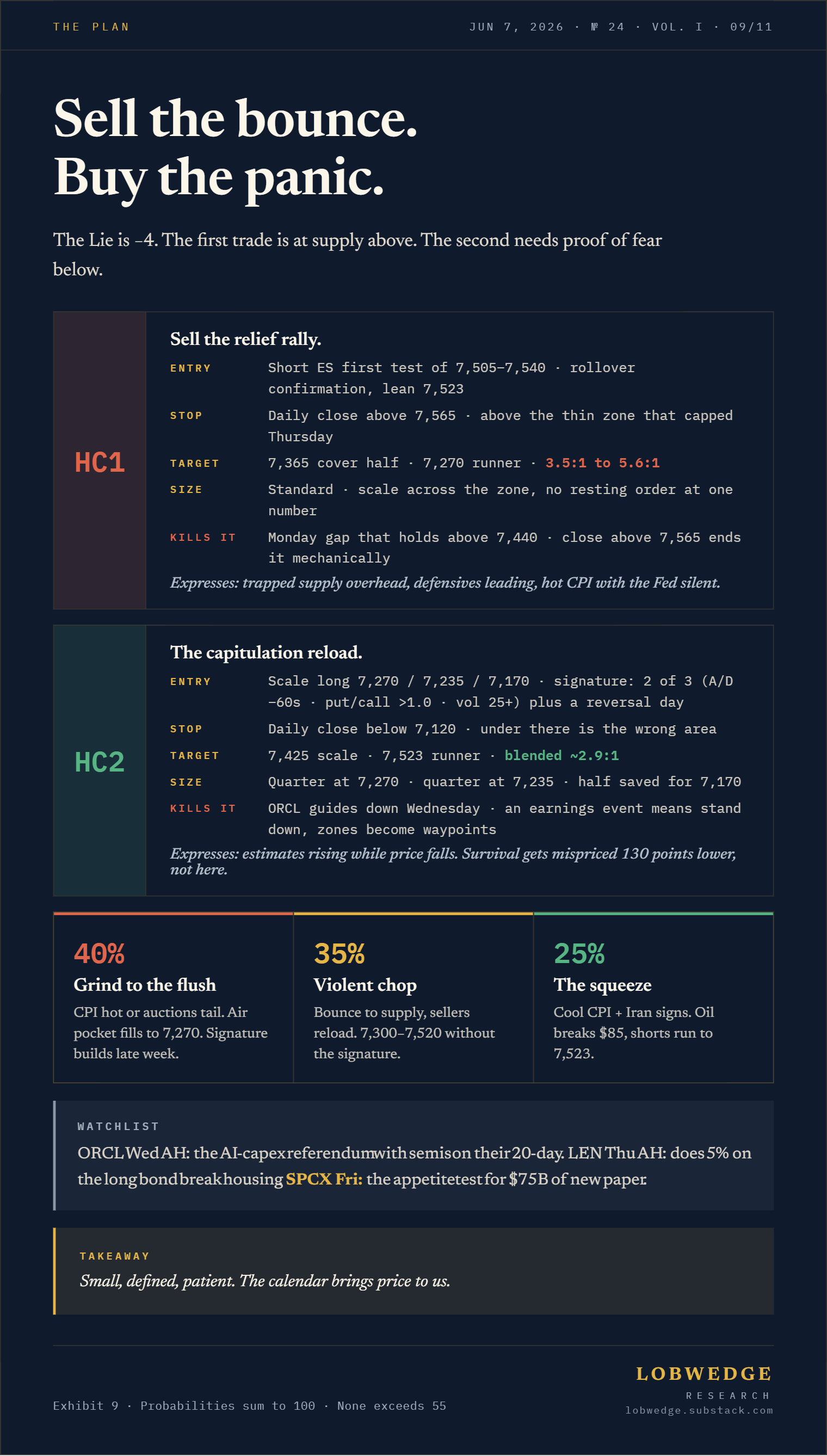
The Plan
HIGH CONVICTION
HC #1: Sell the relief rally. Structure: Short ES on the first test of 7,505-7,540, lean at 7,523. Entry: Scale into the zone. Rally-and-rollover confirmation, not a resting order at the number. Stop: Daily close above 7,565, above the thin zone that capped Thursday. Target: 7,365 first (cover half), 7,270 runner. R:R: entry 7,523, risk 45 points, targets 158 and 253 points. 3.5:1 to 5.6:1. Expresses: The Lie at -4, defensives leading, trapped supply overhead from Thursday’s failed dip-buy, and a hot-CPI setup with the Fed silenced. The crowd that bought Thursday wants out even, we’re selling them the exit. What is wrong: WWDC plus an Iran signature produces a Monday gap that holds above the value roof at 7,484. A close above 7,565 kills it mechanically.
HC #2: The capitulation reload. Structure: Scale long ES at 7,270, 7,235, and 7,170. A quarter at each of the first two, half saved for 7,170. Signature required. Entry: ONLY with the flush signature. Three readings: advance-decline momentum in the minus-60s, total put/call above 1.0, vol above 25. Any two of the three, plus a high-volume reversal session, qualifies. No signature, no trade. The level alone isn’t enough. Stop: Daily close below 7,120. Under there is the wrong area, the deep shelf is broken and the thesis is wrong. Target: 7,425 retest first (scale), 7,523 runner. R:R: size-weighted entry ~7,211, risk ~91 points, targets 214 and 312 points. 2.4:1 first scale, 3.4:1 on the runner, blended ~2.9:1. Expresses: Q2 earnings estimates rising while price falls, a positioning event with intact fundamentals. Survival isn’t mispriced yet at 7,400. It starts getting mispriced 130 points lower, and the signature tells us when the sellers are done. What is wrong: ORCL guides down Wednesday and turns a positioning event into an earnings event. Then the reload zones are waypoints, not destinations, and we stand down.
Scenarios:
Path A (40%): Grind lower to the flush. CPI hot or auctions tail. ES breaks 7,365 and holds below it, fills the gap to 7,270, and the capitulation checklist starts printing late week. HC #1 pays first, HC #2 activates.
Path B (35%): Violent chop. Bounce to supply Monday-Tuesday on WWDC and oversold conditions, sellers reload at 7,505-7,540, range trades 7,300-7,520 without the signature printing. HC #1 pays smaller, HC #2 stays holstered.
Path C (25%): The squeeze nobody owns. Cool core CPI plus a signed Iran deal. Oil breaks $85, yields reverse, ES reclaims 7,484 and runs the shorts to 7,523. Both HCs stand down, the defensive lean dies by its own published rules.
Watchlist: ORCL Wednesday night is the AI-capex referendum with semis sitting on their 20-day. LEN Thursday is the cleanest read on whether 5% long bonds broke housing. SPCX Friday tells you if there’s appetite for $75 billion of new paper in a de-risking market.
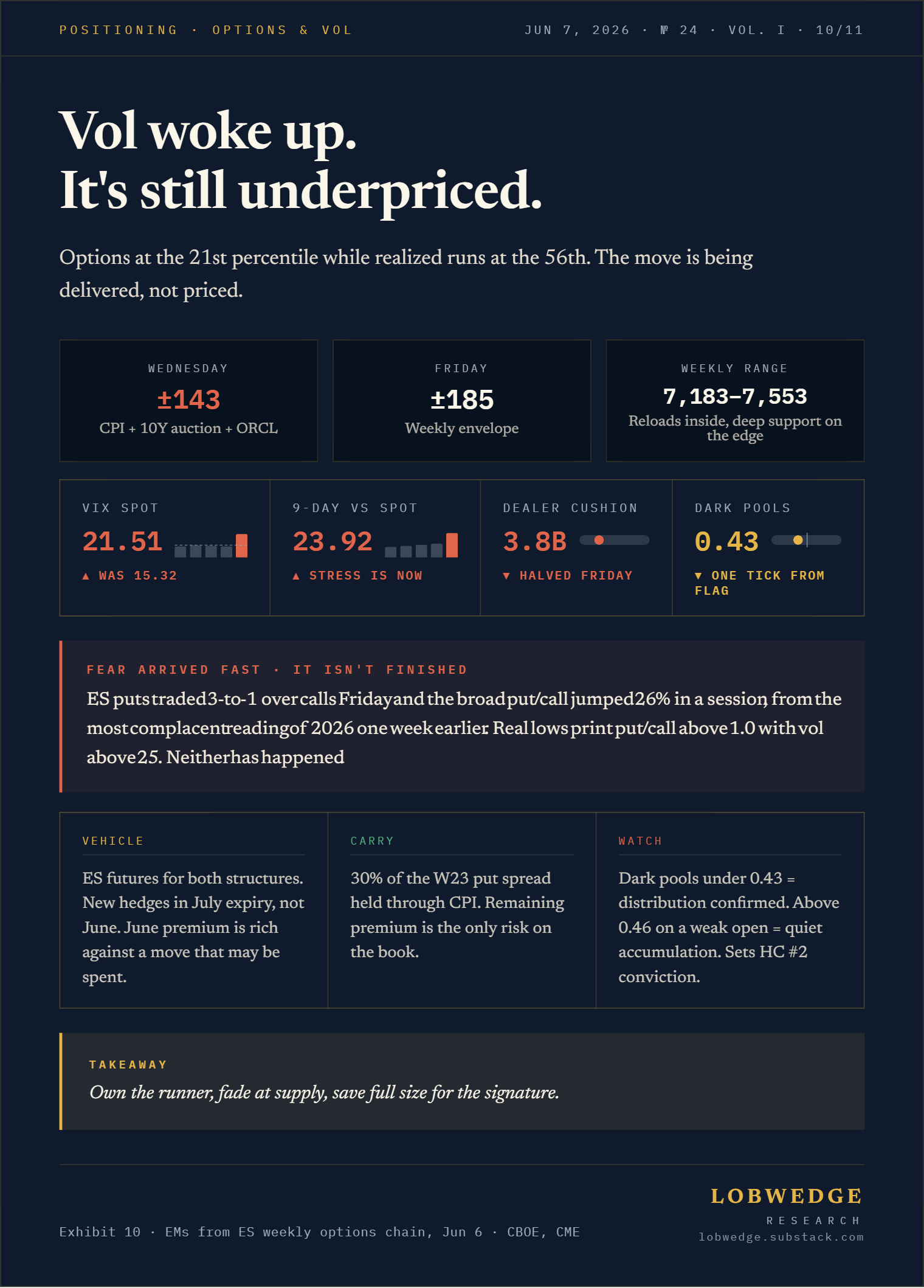
Positioning
The vol market made up its mind in one session. VIX 21.51, was 15.32 last Sunday. The 9-day reading sits above spot, short-term stress priced higher than the month. The asymmetry that remains: ES options trade in the low end of their one-year range while realized volatility runs above its median. Protection got more expensive and is still cheap relative to what’s being delivered.
Expected moves, the ranges option prices imply, what traders are collectively paying for rather than anyone’s prediction: Monday ±85, Wednesday (CPI plus the 10-year auction plus ORCL) ±143 cumulative, Friday ±185. Weekly range 7,183-7,553. The first two reload zones sit inside the envelope, the third right on its edge.
Dealer positioning thinned out fast. The hedging cushion that compressed every dip for nine weeks halved on Friday. Below the value floor, dealers stop dampening moves and start chasing them. That’s how 30-point air pockets become 100-point air pockets.
Dark pools read neutral-to-heavy at 0.43, one tick above the threshold where our regime model flags institutional distribution. Watch Monday’s print: under 0.43 confirms institutions selling the break, above 0.46 with a weak open says they’re quietly accumulating the flush. That single number sets the conviction on HC #2 more than anything on the chart.
Vehicle: ES futures for both structures. The put-spread runner from W23 is the only options position worth carrying through CPI, June premium is now rich against a move that may already be spent. If re-hedging after the bounce, July expiry, not June.
What moves The Lie off the floor: a daily close above 7,523, OR advance-decline momentum back above zero for three consecutive sessions, OR the flush signature printing at a reload zone. That last one matters most: capitulation scores positive once it actually happens, selling exhaustion flips on a down day with shrinking volume, and put/call through 1.0 flips the institutional read. The score can bottom and turn up while price is still falling into 7,270. That’s the sequence we’re waiting for.
Catalysts
Q2 earnings grow 21.7% on consensus and estimates are still being revised up, the selloff hasn’t touched the fundamental engine yet. Guidance confirms it: 61 of 108 companies guiding on Q2 guided positive, 56%, above both the 5- and 10-year averages.
Monday Jun 8: WWDC keynote 1pm ET, Apple’s AI Siri rebuild. CPB before the open. No data. Tuesday Jun 9: NFIB 6am. Trade balance 8:30am. Existing home sales 10am. 3-year auction 1pm. Wednesday Jun 10: CPI 8:30am (headline 4.2% y/y consensus, core 2.9%). 10-year auction 1pm. CHWY before open. ORCL after close. Thursday Jun 11: PPI 8:30am (prior two prints ran hot). Claims. 30-year auction 1pm. ADBE, RH, LEN after close. SpaceX IPO prices tonight. World Cup opens. Friday Jun 12: SPCX lists on Nasdaq. UMich sentiment 10am. Buyback blackout windows begin opening.
Outside the week: FOMC June 16-17, Warsh’s first meeting as Chair. One wrinkle from weekend reporting: he’s staffing up with advisers who want to rework how the Fed communicates, so even the dot plot’s format isn’t guaranteed at this meeting. Treat everything about June 17 as live, including the furniture. Quad witch Friday June 19, the quarterly expiration where index futures and options all roll at once and dealer positioning resets. PCE June 25. Tariff watch for July: the new 60-economy proposal has hearings July 7, and the struck-down tariff authority expires July 24. Dormant for this week, loaded for next month.
The Close
Core: flat the index, defensive posture. Expresses: The Lie at -4, every published downgrade condition fired.
Tactical: short the first test of 7,505-7,540, stop on a close above 7,565, targets 7,365 then 7,270.
Reload: scale longs 7,270/7,235/7,170 only with the flush signature, half the size saved for 7,170. Stop on a close below 7,120.
Runner: 30% of the W23 put spread held through CPI.
Flip: a close above 7,523 or three sessions of advance-decline repair ends the defensive lean.
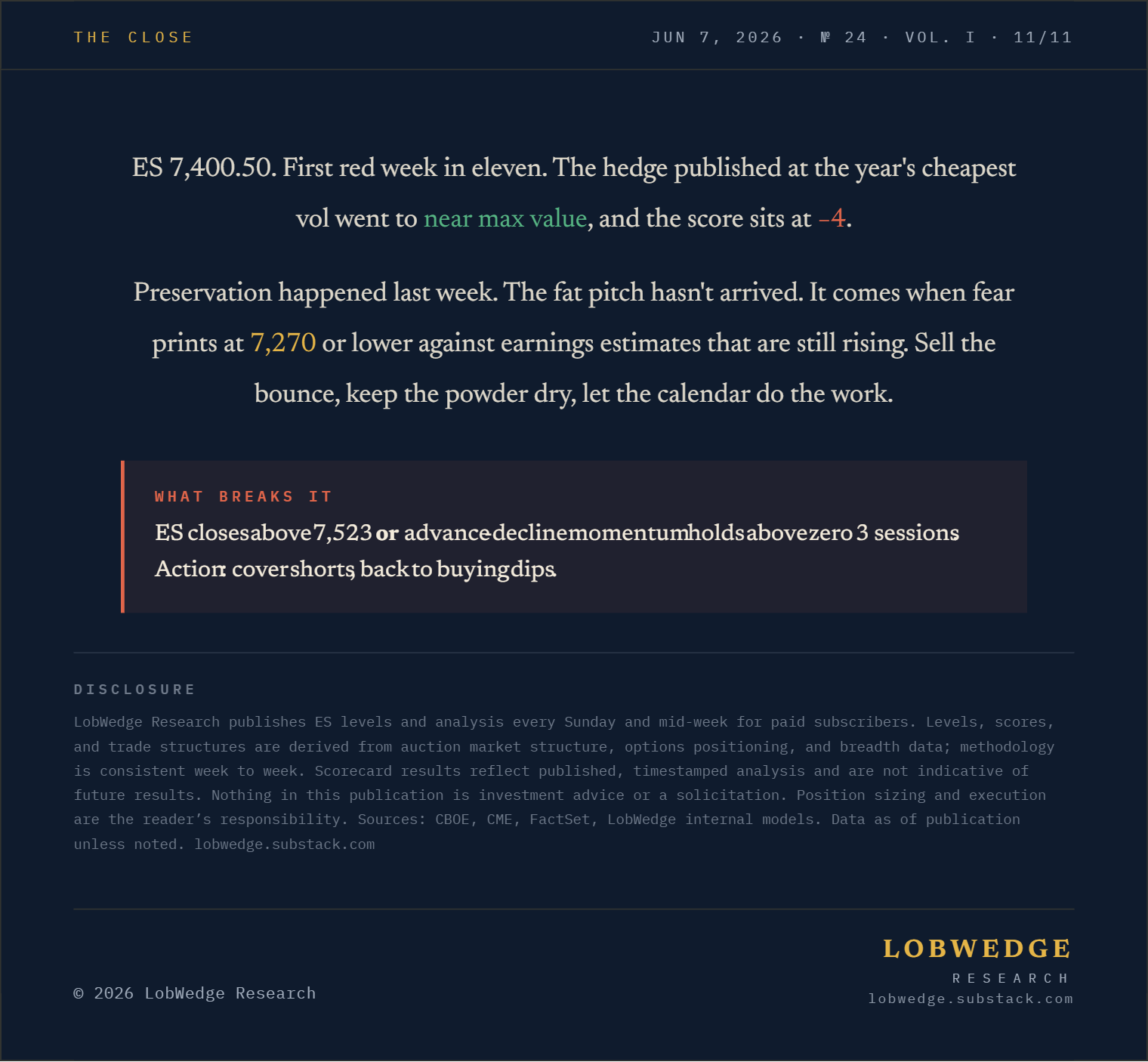
What Breaks It. The defensive lean is dead if ES closes above 7,523 OR advance-decline momentum holds above zero for three consecutive sessions. If either triggers: cover shorts, drop the fade bias, and go back to buying dips at the pivot with normal size.
Druckenmiller’s rule is that big returns come from preservation plus the occasional fat pitch. Preservation happened last week. The fat pitch arrives when fear finally prints at a price where survival is mispriced against rising estimates. Until then the job is small, defined, and patient. The process that called caution at the highs now has to buy fear at the lows. That’s the harder half.
TradingView levels (copy-paste into price alerts or horizontal lines):
7523  Swing High - Reclaim = momentum back, first test = fade zone
7484  Value Roof - Close above = breakdown failed, shorts off
7425  Pivot - Three-week line, broke Friday, now the test
7365  Value Floor - Late Friday went out here, below = air pocket
7270  First Reload - Buyers must show, signature required
7235  Second Shelf - Scale zone if the flush extends
7170  Deep Support - Third reload scale, size saved here
7120  Wrong Area - Reload dead on a close below, stand down
If something here helped your week or you think something’s off, reply. Feedback makes this better.
LobWedge Research provides market analysis and educational content only. Nothing here is investment advice. All trading involves risk. Do your own research and consult a licensed advisor before making any decisions. The author may hold positions in securities mentioned.
Thank you for your discipline and insight. Your defined process cannot be replicated, in my opinion. I generally do not keep close tabs on the day to day or week to week underpinnings, but your knowledge keeps me in touch and provides top tier value to me.
Thanks. For anyone interested, here are my May CPI estimates which have been better than Wall Street 70%-75% of the time:
https://arkominaresearch.substack.com/p/may-2026-cpi-estimate