

This is Post 4 of The Second Read, a weekly series on how markets work two levels deep. If you’re just joining, start with the intro. This post builds directly on Post 3: The Best Trades Are the Traps.
You’ve probably had this experience.
You called the move correctly. The level, the direction, the timing. You watched the setup develop all week. Sunday, the plan said exactly this. By Wednesday, the conditions confirmed. You took the trade.
Then it stopped you out.
Not because you were wrong. Because the market briefly pushed through your stop level before reversing hard exactly the way you said it would. You sat there watching the thesis play out in real time, on the chart you’d been watching for days, in the direction you called, without you in it.
That feeling, reading something right and still not getting paid, is one of the most frustrating experiences in active trading. And it happens more than most traders admit.
I’ve had the other version too. The setup was fully confirmed. Everything the Sunday plan described was present. I sized it like an average trade because something in me wasn’t quite sure enough to go bigger. The move ran 60 points. I captured 18. I closed it out, told myself it was a win, and spent the rest of the day watching the market hit my original target without me.
Technically a win. Practically a miss on the trade of the month.
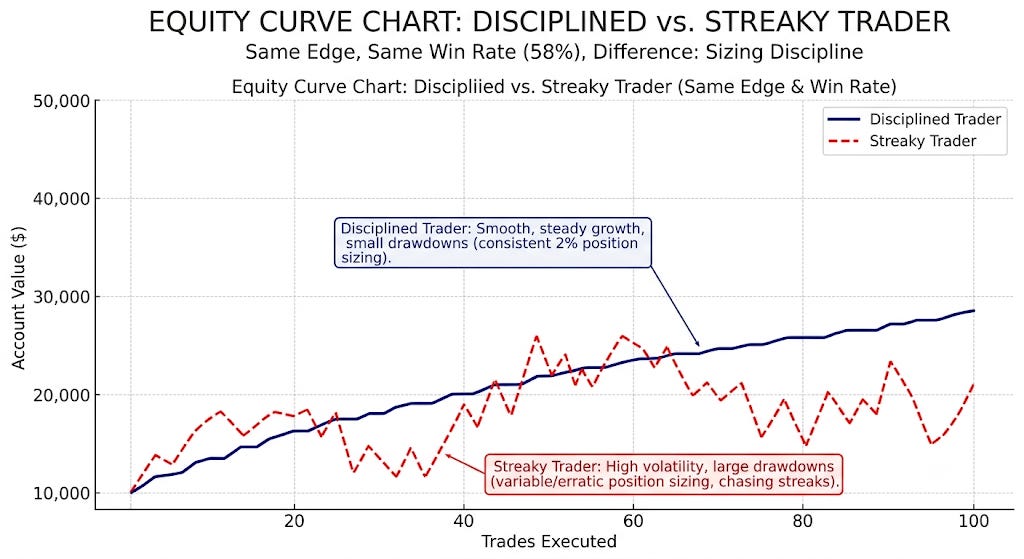
If I’m being honest about my own pattern, the second mistake is the one that costs me more. Not the blowup from sizing too big on a bad trade. The quiet erosion that comes after a run of good calls.
Overconfidence, for me, doesn’t arrive as recklessness. It arrives as drift. Four good weeks and the sizes are creeping up on everything. Not because the setups got better. Because the recent results made me feel like the edge was bigger than it actually was.
The market changes personality.
The regime that rewarded patience and directional trades shifts into something choppier. Levels that held cleanly for weeks start getting sliced through. The setups still look the same on the chart. The conditions still appear to confirm. But the market is behaving differently and you haven’t noticed yet because the last four weeks felt too good to question.
So you keep sizing the weak setups the same way you sized the strong ones. The market zigs when you expected it to zag. A stop gets hit that shouldn’t have. Then another. Not because the analysis was wrong in isolation but because the environment changed and your sizing didn’t change with it.
Markets have a rhythm and a personality. Some weeks trend cleanly and reward conviction. Others chop and punish anyone who presses. The best traders aren’t just reading the setup. They’re reading whether the current market personality supports the size they’re considering. Staying in tempo with what the market is actually doing, not what it was doing last month, is what keeps the sizing honest.
That’s where the drawdowns come from. Not from one bad trade. From carrying last month’s confidence into this month’s market.
What I’ve learned is that the streak is the warning sign, not the green light. When everything is working, that’s exactly when to ask whether the market has changed on you. Not smaller across the board. Ruthlessly specific about whether the current environment still supports the size.
Both mistakes, the one that stopped you out too early and the one that left you undersized on the best trade of the month, come from the same place. Not from reading the market wrong. From not knowing how to build a trade structure around a correct read.
Finding edge is the first problem. Getting paid for it is the second. Almost everyone spends their entire career on the first and wonders why the second never arrives.
By structure, I mean four things: where you enter, where you exit if you’re wrong, where you take profit when you’re right, and how much you risk to get there. Those four decisions, made before the trade is placed, determine whether a correct read becomes a profitable trade or a frustrating near miss. Most traders think about the first one. The other three are where the money actually lives.
The mistake nobody talks about
Druckenmiller’s point is simple: the great traders are not just right more often. They know when to press.
Research on what separates elite investors from average ones lands in the same place. The frequency of being correct barely matters. What matters is how much you make when you’re right versus how much you lose when you’re wrong. Almost all firms spend their energy finding edge. Position sizing gets almost none of the attention.
Most trading education covers one side. Don’t oversize. Don’t blow up. Correct.
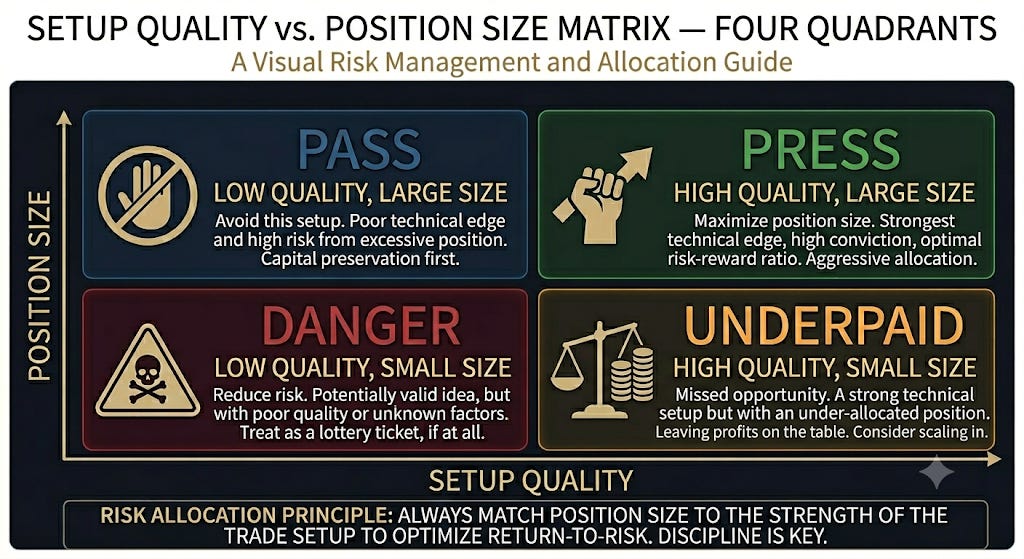
Nobody talks about the other side. The side where a great setup gets sized like an average one because the trader wasn’t sure enough to press.
When the setup is fully confirmed and every condition is met, the mistake is not being big enough.
Being too small on a confirmed setup is the same category of error as being too large on a weak one. Different direction. Same result.
Why being right is only half the job
The two trades I described at the top aren’t really about size. They’re about structure.
The first one had a stop at the textbook level. Just above the broken resistance. Logical. The problem is that a textbook stop is built for the scenario where you’re right and the market moves immediately in your direction. It doesn’t account for noise, for a brief push through the level before the real move starts, for the market taking its time while you sit there. The stop was placed for a perfect trade. Markets don’t run perfect trades.
The second one had a different problem. The stop was right. The target was identified. The size was calibrated to anxiety rather than to the quality of the conditions. When everything in the plan aligns and you still size like you’re uncertain, the emotional version of doubt has overridden the analytical version of confidence. The position is lying about your conviction.
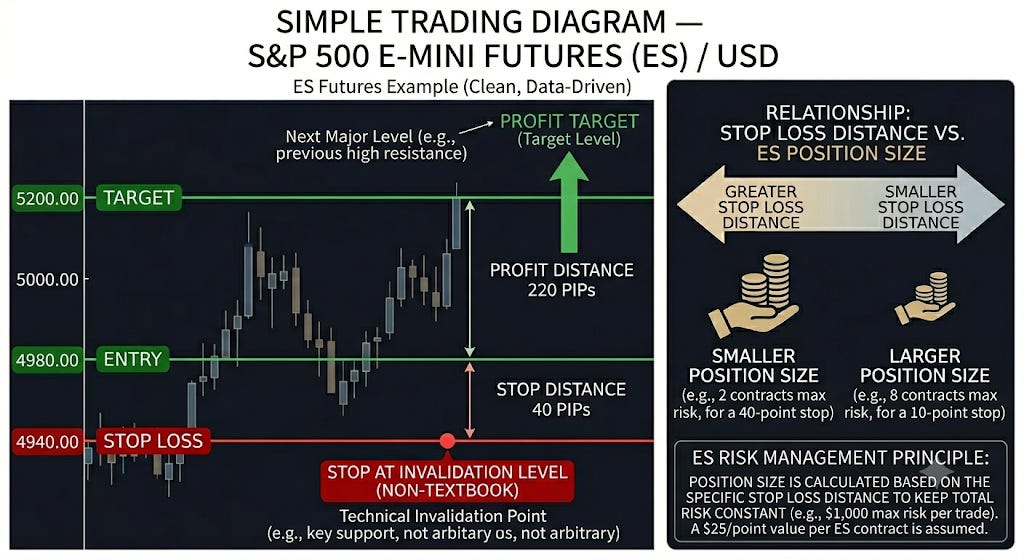
Structure is entry, stop, target, and size in relationship to each other. When that relationship is right, the trade can survive the market being complicated. When it’s wrong, you’re either too fragile to hold through normal movement or too small to matter when you’re right.
Philip Tetlock, a psychologist at the University of Pennsylvania, spent twenty years tracking expert forecasters across politics, economics, and finance and published the results including how badly the experts did. Most researchers who study expert judgment skip that last part.
The ones who performed worst structured their decisions for the outcome they expected. Stops at the textbook level. No room for noise. Built for the trade that works immediately, not the one that takes time.
The ones who performed best structured for the range of outcomes. Their trades could survive being right in a complicated way.
Here is what that looks like on the plan.
The setup confirms at a key level. The Sunday plan identified it. The thesis says sellers fail here and the move runs to the next level on the map. Two traders take it.
The first places a stop 6 points above entry. Textbook. Wednesday morning price probes 8 points through the level for twenty minutes before reversing hard. Stopped out. The trade ran 28 points without them.
The second asked a different question. Not: where does the chart prove me wrong immediately. But: where is the thesis actually invalidated. The answer was the level above the stop cluster, where a real hold would confirm the breakout. Stop goes there, 18 points away. Smaller size, same dollar risk. The probe didn’t touch it. The reversal ran. The target hit.
Same thesis. Same read. Same market.
The stop placement is not a signal of how confident you are. It is a signal of what question you were asking.
There is one more layer to this that most trading content never touches.
Most of what moves price intraday isn’t humans making decisions. It’s automated systems executing programs. In modern markets direction can change in an instant. Not because a thesis was wrong. Because an algorithm hit its target, completed its program, and stopped. The buying that was moving price didn’t fade gradually. It turned off like a switch.
Understanding structure today means understanding where those machines are likely to change behavior. Not predicting what they’ll do. Reading the footprints they leave.
Volume that spikes and then vanishes. Price that reaches a level and stalls without the follow-through you’d expect from genuine conviction. A probe through a level that comes straight back within minutes.
Those aren’t random. They’re the signature of automated execution completing and stepping away. And once you know what you’re looking at, the level on the chart stops being just a technical observation. It becomes a hypothesis about where machine behavior is likely to shift and what the trade looks like when it does.
This is what the Sunday plan is actually built around. Not just where price might react. But where the options positioning, the volume structure, and the expected range from the options market suggest machines are most likely to change behavior. When price reaches one of those levels and the footprint is there, the volume spike that fades, the probe that reverses, the first pullback that finds no buyers, you’re not just reading a chart. You’re reading where the machines handed the market back.
The edge isn’t predicting what happens next. It’s identifying where that handoff is likely to occur and being positioned on the right side of it when it does. The Sunday plan identifies those levels before the week starts.
This is what makes options so powerful in this context. Once you know where the machines are likely to change behavior and what the trade looks like when they do, options let you align your view with that structure in a way that futures alone can’t. Defined risk on the downside. Asymmetric payoff when the thesis plays out. You’re not just taking a directional bet. You’re constructing a position that fits the specific shape of the opportunity — the level, the expected move, the timing, the regime. That precision is what makes options the most efficient expression of a well-structured trade.
The difference between confidence that works and confidence that costs you
Confidence is what you feel. Structure is what gets you paid.
This is not an argument against confidence. That framing misses the point entirely.
There are two kinds and they behave completely differently.
Emotional confidence builds on streak and recency. On the feeling that you’ve been right lately and therefore the current trade is probably right too. It drifts upward during good runs regardless of whether setup quality has actually changed. It answers one question: have my recent trades worked?
Earned confidence builds on conditions being met. When the bias is aligned with the regime, the level has confirmed, and the Sunday plan conditions are all pointing the same direction, that is specific conditional information. The plan told you what to look for. The market delivered it. This answers a different question: does the evidence support this specific trade right now?
Only one of these deserves size. And the discipline is knowing which one you’re feeling in real time.
This is why Sunday nights start with three scenarios for the week.
Not because the market follows a script. But working through three probability-weighted outcomes before Monday open forces a specific question: where does the asymmetry actually sit? Which levels are most likely to produce strong reactions?
By the time those questions are answered, the high-conviction setups are already identified. The levels are mapped. The conditions are written.
When price approaches one of those levels mid-week you’re not deciding in real time whether to take it. You already decided. You’re confirming. That’s earned confidence. The plan built it Sunday when you were thinking clearly.
The math says the same thing. Size should be proportional to the edge in this specific setup, not your average confidence across all trades.
When the regime, the level, and the confirmation align, the trade deserves more size. When they don’t, it doesn’t. Undersizing a high-edge situation destroys compounding just as surely as oversizing a low-edge one. Both are mistakes. Only one gets talked about.
The question that tells you everything
When a position doesn’t feel right, when you’re checking it constantly, when you can’t step away from the screen, that discomfort is information. Either the position is wrong or it’s too large for your current conviction level. Either way the answer is the same: reduce.
Before any trade I plan to hold overnight I ask one question.
If this is down significantly tomorrow morning, can I still trade the same way next week?
Not would I be happy about it. Just: would I still be able to function? Same process, same discipline, same ability to take the next setup without this one sitting in my head.
If the answer is no, I’m too big.
The cost of being oversized isn’t only the money. It’s every decision you make while you’re in it. You take profits early because relief feels better than math. You hold losers too long because the pain is too much to admit. You check price at midnight. Then 2am.
You’re not trading anymore. You’re hoping.
When the position is too large every tick becomes a referendum on whether you should still be in. The size takes your patience before the thesis has time to play out.
The overnight test runs in both directions. The part most traders never ask: when everything is confirmed, am I pressing hard enough?
The traders who compound at the highest levels don’t size their best ideas the same as their average ones. The question is not whether the size is too big. It is whether it is big enough to matter.
Why the same trade is a different trade next week
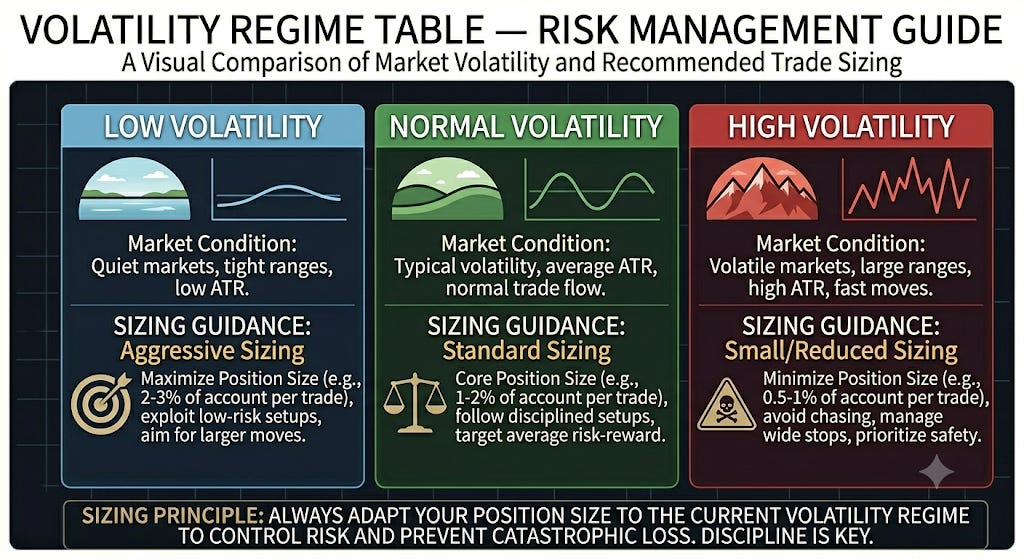
The overnight test isn’t a fixed number. A position you can sleep through in a 30-point expected weekly range becomes dangerous in an 80-point one. Same setup. Same conviction. Different environment. Different size.
Vol regime is just a way of describing how much the market is moving day to day. A quiet trending week feels completely different from a volatile news-driven week. The size that works in one can wreck you in the other.
This is why the Sunday plan flags the vol regime before the week starts. Size so that a full adverse move, not just your stop but the full expected range, still passes the overnight test. If it doesn’t, you’re carrying too much regardless of how good the setup looks.
What changes on Sunday night
Here is what changes on Sunday night.
On ES with an 80-point expected weekly range, an 8-point textbook stop may feel disciplined but a 22-point invalidation stop is the real structure. Wider stop, smaller size, same dollar risk. You survive the noise. You’re still in when the move starts.
Three questions before every trade during the week:
Is this a setup the plan identified, or does it just look familiar? Earned confidence comes from the plan. Emotional confidence comes from the chart looking like something that worked recently.
Does the structure hold? Stop where the thesis is wrong, not where it feels safe. Target real, not optimistic. Reward to risk minimum 2.5 to 1.
Run the overnight test in both directions. Can I survive being wrong? Given how aligned the conditions are, am I pressing hard enough?
The answer to those three questions is the position size. Not what confidence says. What the conditions justify.
Back to where we started
Go back to the opening.
Same read. Same thesis. Same market. This time the stop is at the level where the thesis is actually wrong, not the textbook level. Wider stop, smaller size, same dollar risk. The position survives the noise. The move starts. You’re still in it.
Thursday morning the target hits. You captured most of it.
The read didn’t change. The structure did.
The traders who compound over time lose small when they’re wrong and win large when they’re right. Not because they read markets better. Because the structure is built before the trade appears, when thinking is clear and emotion hasn’t arrived yet.
The structure is what bridges the read and the result.
Next — Post 5
If this one resonated, forward it to someone who has been right about a trade and not gotten paid for it. Questions, just reply.
LobWedge Research provides market analysis and educational content only. Nothing here is investment advice. All trading involves risk. Do your own research and consult a licensed advisor before making any decisions. The author may hold positions in securities mentioned.
So on point